
Most B2B marketers treat lead generation as a volume game. Get more contacts, run more ads, send more emails. The problem is that volume without structure produces a pipeline full of the wrong people. Understanding what is a lead generation funnel, and how it differs from simply collecting names, is the foundation of any marketing programme that actually converts. This article breaks down the funnel stages, the qualification criteria that matter, and how to build a process that hands sales teams leads worth pursuing.
Table of Contents
- Key takeaways
- What is a lead generation funnel?
- Lead funnel stages: TOFU, MOFU, and BOFU
- MQLs vs SQLs: the qualification gap
- B2B funnel complexity: stakeholders and cycles
- Building and optimising your funnel
- My take on what most B2B funnels get wrong
- Ready to build a funnel that actually converts?
- FAQ
Key takeaways
| Point | Details |
|---|---|
| Funnels are not sales tools | The lead generation funnel is marketing-owned and ends at the qualified lead handoff, not at the closed deal. |
| Stages require different content | TOFU, MOFU, and BOFU each demand distinct offers and messaging matched to buyer intent. |
| MQL and SQL are not interchangeable | Only around 13% of MQLs convert to SQLs in B2B, so qualification criteria must be explicit. |
| B2B funnels are multi-stakeholder | Effective funnels segment messaging by role, addressing technical evaluators and executives differently. |
| Speed and gates both matter | Treating funnel progression as qualification gates, combined with fast lead response, drives measurable conversion improvement. |
What is a lead generation funnel?
A lead generation funnel is the step-by-step process that moves prospects from first awareness of your brand through to a qualified lead ready for sales engagement. It is a deliberate sequence, not a passive collection mechanism. Each stage is designed to build trust, gather intent signals, and filter out contacts who are not yet, or never will be, a fit.
The term “lead generation funnel” is widely used in marketing circles, though the recognised industry framework sits within the broader concept of what is a marketing funnel. The lead generation funnel specifically covers the marketing-owned portion of that broader framework.
How it differs from a sales funnel
This distinction matters more than most organisations acknowledge. The lead generation funnel and the sales funnel are adjacent but separate processes with different owners and different goals.
| Dimension | Lead generation funnel | Sales funnel |
|---|---|---|
| Owner | Marketing | Sales |
| Starting point | Anonymous visitor or prospect | Marketing qualified lead (MQL) |
| Ending point | Sales qualified lead (SQL) | Closed deal |
| Primary goal | Attract, educate, and qualify | Engage, negotiate, and convert |
| Key metrics | Cost per lead, MQL volume, conversion rate | Pipeline value, win rate, deal velocity |
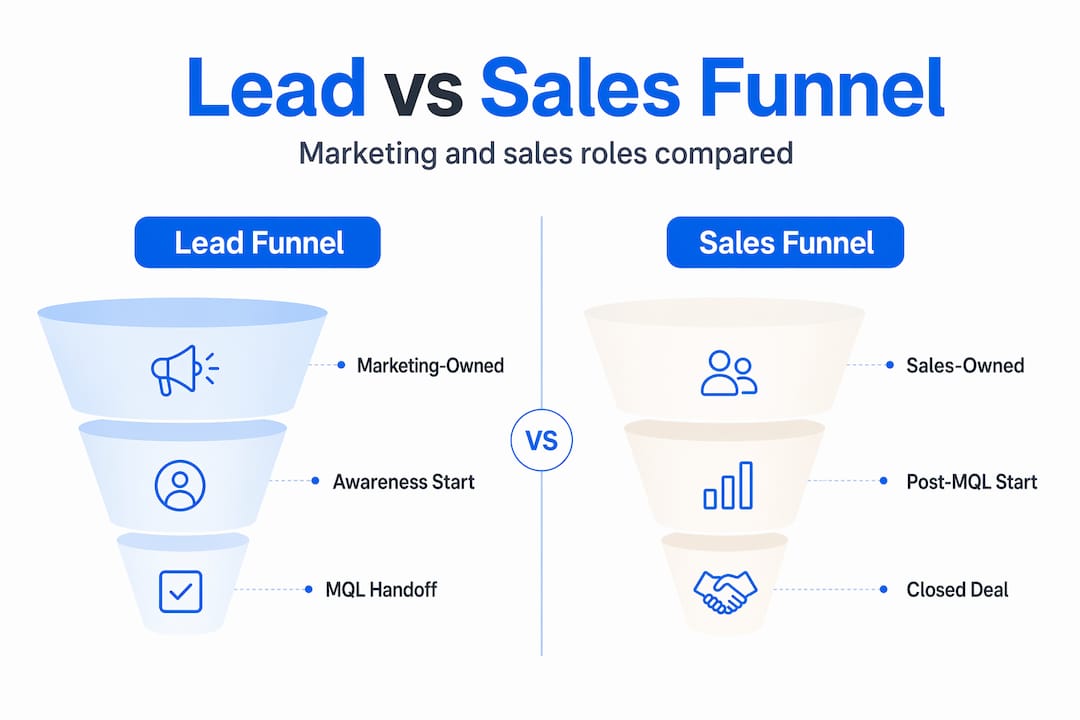
The lead funnel is marketing-owned, focused on attracting visitors and qualifying leads before handoff. The sales funnel begins post-qualification and focuses on closing. Conflating the two creates accountability gaps where neither team owns the middle of the process, and leads fall through.
Lead funnel stages: TOFU, MOFU, and BOFU
The funnel divides into three stages: top of funnel (TOFU), middle of funnel (MOFU), and bottom of funnel (BOFU). Each stage reflects a different level of buyer intent and requires a different approach to content, offers, and lead capture.
Top of funnel (TOFU): awareness
At this stage, prospects are identifying a problem. They are not yet evaluating solutions. Your goal is broad education and brand visibility, not a sales pitch. Offer formats that work well here include blog articles, short-form video, social content, and downloadable guides on industry problems.
Lead capture at TOFU should be low friction. A simple email opt-in in exchange for a checklist or introductory ebook is appropriate. Asking for a phone number, company revenue, and job title at this stage will kill your conversion rate.
- Blog posts addressing common industry pain points
- Downloadable checklists or introductory guides
- Short educational video content
- Webinar registrations on broad topics
- Social media lead ads with simple opt-in forms
Middle of funnel (MOFU): consideration
Prospects at MOFU are actively comparing options. They know their problem and are evaluating whether your solution is the right fit. Content here needs to go deeper: case studies, comparison guides, in-depth webinars, and product-focused ebooks all perform well.

Lead nurturing is the primary mechanism at this stage. Automated email sequences that deliver progressively more specific content keep prospects engaged and signal intent through click behaviour and content consumption patterns.
Bottom of funnel (BOFU): decision
At BOFU, the prospect is close to a buying decision. Friction removal is the priority. Free trials, personalised demos, ROI calculators, and direct consultations are the right offers. Your calls-to-action should be specific and direct, not generic “learn more” prompts.
Aligning forms with funnel stage intent is one of the highest-leverage improvements you can make. A BOFU landing page can reasonably ask for company size, industry, and current tech stack because the prospect’s intent justifies the effort.
Pro Tip: Map every content asset and landing page in your funnel to a specific stage. If you cannot immediately say whether a piece is TOFU, MOFU, or BOFU, it is likely doing nothing measurable for your pipeline.
MQLs vs SQLs: the qualification gap
Understanding the difference between a marketing qualified lead and a sales qualified lead is where most B2B funnels either succeed or stall. MQLs are engaged contacts still being nurtured by marketing. SQLs are contacts that have met explicit criteria indicating readiness for a sales conversation.
The gap between the two is significant. Only about 13% of MQLs convert to SQLs in B2B, which means the majority of leads that marketing celebrates as wins are not yet ready for sales. This is not a failure of volume. It is a failure of qualification criteria.
Defining MQL and SQL criteria
MQL criteria typically combine behavioural signals (content downloads, email opens, webinar attendance, page visits) with firmographic data (company size, industry, geography, revenue). A contact who downloads three resources and works at a company in your target segment is an MQL. A contact who requests a demo after attending a product webinar is likely an SQL.
The distinction must be written down and agreed upon by both marketing and sales. Confusing engaged leads with sales-ready leads is one of the most common causes of sales and marketing misalignment, and it wastes sales capacity on conversations that should still be in nurture.
| Lead type | Typical criteria | Next action |
|---|---|---|
| MQL | Downloaded 2+ assets, fits target firmographics, opened 3+ emails | Continue nurture sequence |
| SQL | Requested demo, attended product webinar, meets ICP criteria | Sales outreach within 24 hours |
Improving MQL to SQL conversion
Enriching leads with firmographic data before they reach MQL stage filters out unqualified prospects and saves sales time. Tools that append company size, tech stack, and industry to form submissions allow you to score leads accurately without asking prospects to fill in long forms.
Speed of response is the other major lever. Responding to leads within the first hour can increase qualification rates by 7x compared to delayed follow-up. Most B2B organisations are nowhere near this benchmark, which is a straightforward competitive advantage for those who close the gap.
Pro Tip: Set a service level agreement between marketing and sales that defines how quickly sales must respond to an SQL. Without a written agreement, response times drift and leads go cold regardless of how well-qualified they are.
B2B funnel complexity: stakeholders and cycles
B2B lead generation funnels operate in a fundamentally different environment from consumer funnels. Longer sales cycles and multiple decision makers require a more sophisticated approach to content, nurturing, and qualification.
A typical B2B purchase involves between three and ten stakeholders. Each has different concerns, different levels of technical knowledge, and different definitions of value. A single-message funnel that treats all of them the same will underperform against one that addresses each role specifically.
Message segmentation by audience role is the practical solution. Technical evaluators want product depth: integration documentation, security specifications, and feature comparisons. Executive sponsors want ROI focus: cost savings, risk reduction, and strategic alignment. Procurement teams want compliance and contractual clarity. Building content for each persona and routing it appropriately is not optional in complex B2B sales. It is the difference between a funnel that stalls and one that progresses.
Key considerations for B2B funnel design:
- Map every buyer persona involved in the purchase decision, not just the primary contact
- Create content tracks for technical, commercial, and executive audiences
- Build nurture sequences long enough to match your actual sales cycle, which may be six to eighteen months
- Use behavioural gates rather than time-based progression to move leads through stages
- Set explicit firmographic qualification thresholds so the funnel self-filters poor-fit prospects early
Behavioural and firmographic gates that declare when a lead moves stages speed up qualification and routing to sales. This approach treats the funnel as a series of earned progressions rather than a waiting room.
Building and optimising your funnel
Knowing the theory is one thing. Building a funnel that produces measurable results requires a structured implementation process. The lead generation process below is not exhaustive, but it covers the decisions that have the highest impact on funnel performance.
- Define your ideal customer profile. Audience research comes before any content creation. Know the industries, company sizes, roles, and pain points you are targeting. Without this, every subsequent decision is guesswork.
- Create gated assets matched to funnel stages. An introductory ebook for TOFU, a detailed case study for MOFU, and an ROI calculator for BOFU. Each asset should address the specific question a buyer at that stage is asking.
- Build landing pages with stage-appropriate forms. TOFU pages ask for an email. BOFU pages can ask for more. Keep form length proportional to the value of the offer.
- Drive targeted traffic through paid and organic channels. LinkedIn Ads for B2B audience targeting, SEO-driven blog content for organic TOFU, and retargeting campaigns for MOFU and BOFU prospects who have already visited your site.
- Set up automated lead nurturing sequences. Email workflows triggered by specific behaviours, such as a download or a webinar registration, keep prospects engaged between touchpoints without requiring manual effort.
- Track the metrics that reflect funnel health. Cost per lead, MQL volume, MQL-to-SQL conversion rate, funnel velocity, and cost per SQL are the core KPIs. Conversion rate alone tells you very little without knowing where in the funnel drop-off is occurring.
- Iterate based on data, not assumptions. Review funnel metrics monthly. Identify the stage with the highest drop-off rate and test one change at a time to isolate what is driving the improvement.
Aligning sales and marketing through shared metrics and unified processes is what allows funnels to scale. Without that alignment, marketing optimises for MQL volume while sales complains about lead quality, and neither team has the data to resolve the disagreement.
My take on what most B2B funnels get wrong
I’ve worked with enough B2B marketing teams to recognise a pattern that repeats itself regardless of company size or industry. Marketing builds a funnel, fills it with content, and then hands leads to sales the moment someone downloads anything. Sales calls them, finds they are nowhere near ready to buy, and stops trusting the leads marketing sends. The relationship deteriorates from there.
The root cause is almost always the same: funnel stages are treated as timelines rather than qualification gates. A lead who downloaded an ebook three weeks ago is not automatically more ready than one who downloaded it yesterday. What matters is what they did after the download. Did they open the follow-up emails? Did they visit the pricing page? Did they attend the webinar?
In my experience, the funnels that perform best are the ones where marketing and sales have agreed on explicit, written criteria for what constitutes an MQL and an SQL. Not a rough consensus. A written document with specific behavioural and firmographic thresholds. Content mapping to buyer stage prevents premature sales asks and builds the kind of trust that makes the eventual conversation far more productive.
The other thing I’ve seen make a disproportionate difference is multi-stakeholder targeting. Most B2B funnels are built for one persona. The economic buyer, usually. But the technical evaluator who blocks the deal or the procurement manager who adds six weeks to the process are rarely addressed. Targeting them with role-specific content mid-funnel reduces friction at the point of sale in ways that no amount of bottom-funnel optimisation can replicate.
Ready to build a funnel that actually converts?
Understanding the theory behind a lead generation funnel is the starting point. Translating that into a funnel that produces measurable MQL-to-SQL improvement requires precise execution, data analysis, and the ability to identify where your specific funnel is losing qualified prospects.
Anthonyligyat works with B2B companies to build and optimise lead funnels grounded in data, not assumptions. From funnel audits that identify your highest-impact drop-off points to full funnel builds incorporating ebook and quiz formats, the approach is metrics-driven and tailored to your buyer journey. Clients like Yuan Packaging have seen measurable conversion improvements through this process. If you want a funnel that your sales team will trust, explore the consulting services at Anthonyligyat to see how the methodology applies to your business.
FAQ
What is a lead generation funnel in simple terms?
A lead generation funnel is the structured process that moves prospects from first awareness of your brand through to a qualified lead ready for sales. It is owned by marketing and ends at the point of sales handoff.
How does a lead funnel differ from a sales funnel?
The lead generation funnel covers the marketing-owned stages from awareness to qualified lead. The sales funnel begins after that handoff and focuses on converting qualified leads into closed deals.
What are the three main lead funnel stages?
The three stages are top of funnel (TOFU) for awareness, middle of funnel (MOFU) for consideration, and bottom of funnel (BOFU) for decision. Each stage requires different content offers and lead capture approaches.
What is the difference between an MQL and an SQL?
An MQL is an engaged contact still being nurtured by marketing who meets basic behavioural and firmographic criteria. An SQL has met explicit readiness thresholds and is ready for direct sales engagement.
Why do so few MQLs become SQLs in B2B?
Only around 13% of MQLs convert to SQLs in B2B because most organisations lack explicit qualification criteria, resulting in leads being passed to sales before they are genuinely ready to buy.