
Marketing teams make expensive decisions every day based on funnel data that has never been properly verified. When you conduct a marketing funnel data audit, you are not simply checking whether numbers look reasonable. You are running a measurement integrity exercise that compares what your analytics platforms report against what your CRM and finance systems confirm as commercial reality. The gap between those two figures is where budget gets misallocated, channels get cut unfairly, and conversion problems go undiagnosed for months.
Table of Contents
- Key takeaways
- Preparing to conduct a marketing funnel data audit
- Executing the audit step by step
- Common mistakes that derail funnel audits
- Interpreting results and improving performance
- My perspective on continuous funnel auditing
- Get expert help with your funnel audit
- FAQ
Key takeaways
| Point | Details |
|---|---|
| Validate before you optimise | Confirm tracking accuracy and event firing before drawing any conclusions from funnel metrics. |
| Reconcile across systems | Compare platform analytics against CRM and finance data to surface real discrepancies. |
| Audit funnel definitions first | Verify that funnel step definitions match actual user behaviour before investigating data correctness. |
| Attribution models carry bias | Most teams default to last-click, which systematically undercounts upper-funnel channels. |
| Treat audits as ongoing | A one-off audit captures a moment in time. Continuous governance protects data quality long-term. |
Preparing to conduct a marketing funnel data audit
Before you write a single query or pull a single report, you need a clear inventory of every system that touches your funnel data. Skipping this step is the single most common reason audits produce incomplete or misleading findings.
Systems to inventory
Start by mapping every platform that collects, processes, or reports on funnel activity. The list typically includes:
- Web analytics platforms (GA4, Adobe Analytics)
- CRM systems (Salesforce, HubSpot, Zoho)
- Paid media platforms (Google Ads, Meta Ads, LinkedIn Campaign Manager)
- Marketing automation tools (Klaviyo, Marketo, ActiveCampaign)
- Ecommerce platforms (Shopify, WooCommerce, Magento)
- Data warehouses or BI tools (BigQuery, Looker, Tableau)
Each of these systems applies its own attribution logic, session definitions, and conversion counting rules. They will never agree perfectly, and that is expected. What matters is understanding why they differ and whether the differences fall within an acceptable tolerance.
Understanding your attribution model
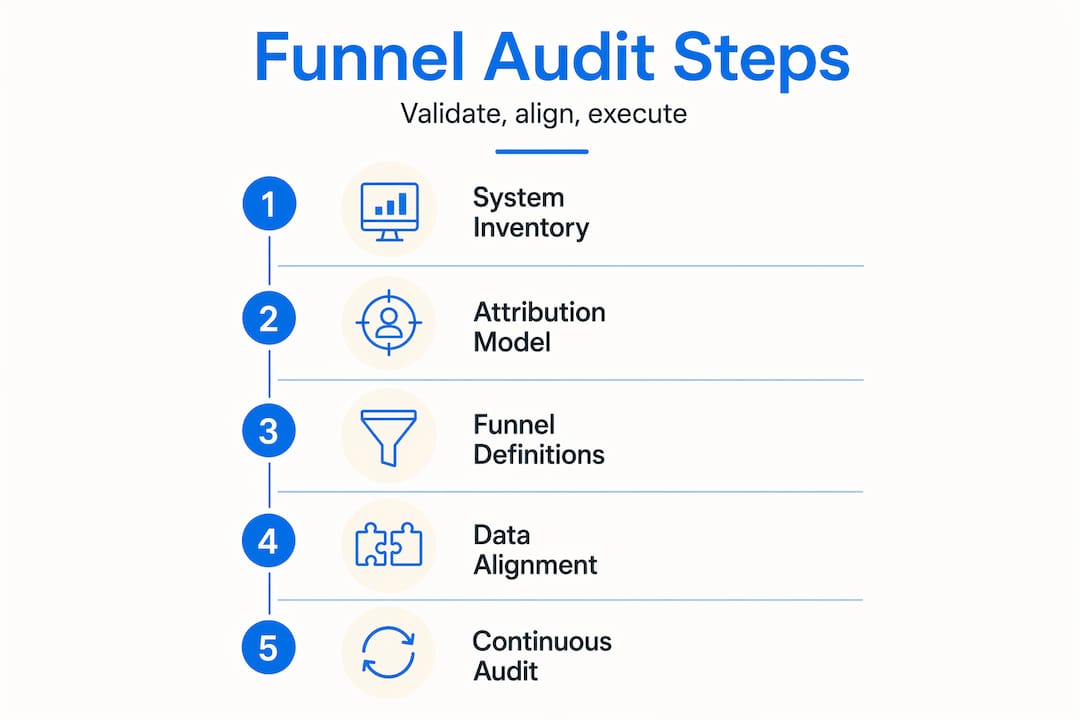
Before you evaluate sales funnel performance, you need to confirm which attribution model each platform is using and whether that model suits your buyer journey. B2B buyers engage across 8 to 12 interactions before converting, which means last-click attribution will systematically misrepresent which channels are actually driving revenue.
The table below outlines the core tools and data requirements you will need at the start of any funnel audit.
| System | Data to collect | Common issues |
|---|---|---|
| GA4 | Events, funnel steps, conversion goals | Misconfigured events, open vs. closed funnel settings |
| CRM | Lead source, deal stage, close date | Inconsistent lead source tagging, missing UTM data |
| Paid media platforms | Conversions, click data, attribution window | Platform-specific attribution inflating results |
| Data warehouse | Joined revenue and marketing data | Incomplete pipeline joins, delayed data syncing |
Aligning on definitions and goals
Before the audit begins in earnest, confirm that all stakeholders agree on what each funnel stage means. What counts as a Marketing Qualified Lead? At what point does a prospect become a Sales Qualified Opportunity? These definitions must be documented and consistent across every system you are about to audit. Without this alignment, you will spend hours chasing discrepancies that are simply definitional, not technical.

Executing the audit step by step
With your systems inventoried and definitions confirmed, you can move into the execution phase. The recommended audit execution flow follows a clear sequence: validate tracking first, then reconcile conversions across systems, then analyse stage conversion rates.
-
Validate UTM parameters and tagging hygiene. Pull a sample of recent campaign URLs and check that UTM parameters are present, correctly formatted, and consistent. Missing or malformed UTMs cause traffic to be misattributed to direct or organic, which distorts every channel comparison you make downstream.
-
Verify event firing and conversion setup. Use your tag management system (Google Tag Manager is most common) to confirm that key events fire correctly on the intended pages and actions. Check for duplicate event firing, which inflates conversion counts, and for events that fire on page load rather than on user action.
-
Reconcile platform conversions against your CRM. This is the most revealing step in any marketing data evaluation. Pull conversion counts from each paid media platform for a defined period, then pull the corresponding lead or sale count from your CRM for the same period. Closed-loop reporting connects these two data sets to expose where platform reporting and commercial reality diverge.
-
Assess funnel step definitions in GA4. GA4 funnels can be configured as either closed or open. Closed funnels track only users who complete steps sequentially, while open funnels allow users to enter at any step. If you are running a designed sequential journey (a checkout flow, for example), a closed funnel is correct. If users arrive via deep links or email, an open funnel better reflects real behaviour. Mismatching the configuration to the journey type produces false drop-off signals.
-
Evaluate attribution model bias. Compare conversion counts under your current attribution model against a data-driven or linear model. The delta between last-click and any multi-touch model reveals which channels are being under-credited. This is particularly significant for B2B funnels where content and social channels contribute early in the journey but rarely get the final click.
-
Test consent management and data loss. Privacy settings are now a material source of data gaps. Advanced Consent Mode in GA4 can recover approximately 65 to 70 per cent of conversion attribution lost to privacy settings, with Enhanced Conversions adding a further 5 to 25 per cent. If you have not implemented consent mode correctly, you are likely underreporting conversions and misreading channel performance.
Pro Tip: When reconciling platform data against your CRM, always use a 30-day window with a 7-day lag to account for delayed conversion reporting. Comparing the same calendar period in real time will almost always produce a false discrepancy.
Common mistakes that derail funnel audits
Even experienced analysts make predictable errors during a sales funnel audit process. Knowing where audits typically go wrong saves you from chasing problems that do not exist, and from missing ones that do.
The most damaging mistake is over-reliance on platform-owned reporting without independent validation. Google, Meta, and LinkedIn each report conversions using their own attribution windows and counting rules. Accepting those numbers at face value, without cross-referencing against a neutral source like your CRM or data warehouse, means you are auditing the platform’s version of reality rather than your own.
A second common failure is treating cross-channel discrepancies as noise rather than signal. When GA4 reports 200 conversions and your CRM shows 140 for the same period, the 60-unit gap is not rounding error. It is a measurement problem that will compound every decision you make about budget allocation, channel mix, and campaign performance.
Skipping funnel step definition validation before investigating event data is another frequent misstep. A mislabelled step or incorrect funnel type creates false drop-off signals that send you looking for technical problems where none exist. Always confirm that the funnel architecture matches actual user paths before you investigate whether events are firing correctly.
Consent mode errors deserve specific attention. Many teams implement basic consent mode but not Advanced Consent Mode, which means they are missing the modelling layer that recovers lost attribution data. The modelling requires a minimum threshold of approximately 1,000 consenting and 1,000 non-consenting daily users over seven or more days to produce reliable results. Sites below this threshold need alternative approaches.
Pro Tip: Build a simple audit governance document that records what was checked, when, and by whom. This creates accountability and makes it far easier to run the next audit, since you already have a baseline to compare against.
Finally, the biggest structural mistake is treating the audit as a one-off project. Data quality degrades continuously as campaigns change, tags break, and platforms update their tracking behaviour. Ongoing governance, including monthly reconciliation checks and quarterly full audits, is the only way to maintain reliable marketing funnel metrics over time.
Interpreting results and improving performance
Once the audit is complete, the real work begins. Raw findings need to be translated into prioritised decisions that improve both data quality and funnel performance.
-
Identify genuine drop-off points. With validated data, you can now trust your funnel visualisation. Look for stages where drop-off exceeds your industry benchmark by a statistically meaningful margin. A 60 per cent drop between lead and MQL in a B2B funnel often signals a lead quality problem, not a volume problem. That distinction changes the entire remediation strategy.
-
Adjust your attribution model based on audit findings. If the audit revealed that your top-of-funnel content channels are systematically undervalued by last-click, shift to a data-driven or position-based model. Marketing analytics success depends on linking cross-channel, lifecycle data to revenue outcomes, not just measuring web sessions in isolation.
-
Prioritise fixes by business impact. Not every tracking error has equal consequence. A misfiring event on a low-traffic page matters far less than a duplicate conversion tag on your primary lead form. Score each issue by the volume of decisions it affects and fix in that order.
-
Establish a measurement framework for ongoing validation. Document your source of truth for each funnel metric, the acceptable tolerance between platform and CRM figures, and the cadence for reconciliation. This framework becomes the operating standard for your marketing data evaluation going forward.
-
Set realistic benchmarks. Post-audit numbers will often look worse than pre-audit numbers, because you have removed inflated or duplicated data. Communicate this to stakeholders before the audit concludes. A lower but accurate conversion rate is more useful than a higher but misleading one.
My perspective on continuous funnel auditing
I have reviewed funnel data across dozens of B2B accounts, and the pattern is remarkably consistent. Teams invest heavily in generating traffic and building campaigns, then make optimisation decisions based on data that has never been independently verified. The result is a kind of confident incompetence. The dashboards look authoritative. The conclusions are wrong.
What experience has taught me is that the most dangerous funnel data is not obviously broken. It is plausible. A 3.2 per cent conversion rate that should be 2.1 per cent does not trigger alarm bells. It just quietly misdirects budget toward channels that appear to be performing and away from channels that are actually contributing.
I also think the industry underestimates how much attribution model selection shapes strategic decisions. When you audit marketing data properly and run the same conversion data through last-click versus a multi-touch model, the implied channel rankings often look completely different. The channel you were about to cut may be the one doing the most work.
The teams that get this right treat auditing as a standing function, not a remediation exercise. They build reconciliation into their monthly reporting rhythm, they document their measurement assumptions, and they revisit those assumptions whenever a significant platform or campaign change occurs. That discipline is what separates data-driven marketing analysis that actually drives decisions from reporting theatre.
Get expert help with your funnel audit

If the audit process outlined here surfaces more complexity than your team has capacity to resolve, that is a common position for growing B2B organisations. Anthonyligyat works directly with marketing teams to run structured funnel audits, reconcile cross-platform data, and build attribution frameworks that hold up under scrutiny. The methodology combines finance-grade rigour with hands-on platform expertise, covering everything from UTM governance to consent mode implementation and CRM reconciliation. Whether you need a one-time diagnostic or ongoing measurement governance, expert funnel auditing from Anthonyligyat gives you data you can actually trust and decisions you can defend.
FAQ
What does a marketing funnel data audit involve?
A marketing funnel data audit is a measurement integrity exercise that validates tracking accuracy, reconciles conversion data across platforms and CRM systems, and verifies that funnel step definitions match actual user behaviour before any optimisation decisions are made.
How often should you audit your marketing funnel data?
Monthly reconciliation checks and quarterly full audits are the recommended cadence. Data quality degrades continuously as campaigns change and platforms update their tracking behaviour, so a one-off audit is never sufficient.
Why do platform conversion numbers differ from CRM data?
Each platform applies its own attribution window, session definitions, and conversion counting rules. Discrepancies between platform dashboards and CRM figures are expected, but gaps beyond a reasonable tolerance signal a tracking or attribution problem that needs investigation.
How does consent mode affect funnel audit results?
Advanced Consent Mode in GA4 can recover approximately 65 to 70 per cent of conversion attribution lost to privacy settings. Sites that have not implemented it correctly will underreport conversions and misread channel performance, which makes consent mode validation a required step in any thorough audit.
What is the biggest mistake teams make during a funnel audit?
The most common failure is relying solely on platform-owned reporting without cross-referencing against an independent source like a CRM or data warehouse. This means the audit validates the platform’s version of events rather than commercial reality.