
Artificial intelligence in B2B marketing is defined by its capacity to automate targeting decisions, personalise campaigns at scale, and forecast pipeline outcomes with a precision that manual processes cannot match. Platforms like Salesforce Agentforce and ActiveCampaign now embed machine learning directly into revenue workflows, shifting AI from a content tool to a strategy execution engine. G2’s 2026 research confirms this shift, noting that the real advantage lies in predictive analytics and real-time optimisation rather than content generation alone. For B2B marketing professionals, understanding the role of AI in B2B marketing means understanding how it changes the economics of lead generation, account targeting, and sales alignment.
How AI improves lead targeting and qualification in B2B
The most measurable impact of artificial intelligence in marketing is its ability to score and prioritise leads dynamically, using intent data, firmographics, and behavioural signals simultaneously. Traditional lead scoring assigns static weights to attributes. AI updates those weights in real time as a prospect’s behaviour changes, which means your sales team is always working the highest-probability accounts rather than last quarter’s assumptions.

AI’s prioritisation logic shifts based on predictive insights and intent changes, not just static rules. This matters because a prospect who downloaded a whitepaper six weeks ago and has since visited your pricing page three times is a fundamentally different lead than one who only completed the initial form. AI catches that distinction automatically; a spreadsheet-based scoring model does not.
Practical applications in this space include:
- AI SDRs that qualify inbound leads through conversational interfaces before routing to human sales reps, reducing response time from hours to seconds
- Next-best-action tools embedded in CRM platforms like Salesforce that surface prescriptive recommendations for each account based on pipeline stage and engagement history
- Intent data integrations that pull signals from third-party sources, combining them with first-party behavioural data to build a richer picture of buying readiness
- Dynamic audience suppression that removes accounts already in active sales cycles from top-of-funnel campaigns, reducing wasted spend
Building a qualified B2B pipeline with AI requires combining these tools with clearly defined handoff criteria between marketing and sales. Without that definition, AI surfaces the right leads and they still get lost in the handoff.
Pro Tip: Set a minimum intent threshold before any AI-scored lead enters a sales sequence. If your AI tool scores leads from 0 to 100, resist the temptation to route everything above 50. Test routing only leads above 70 for 30 days and measure conversion rates at each stage. The data will tell you where the real threshold sits.
How does AI-driven personalisation work at scale in B2B campaigns?
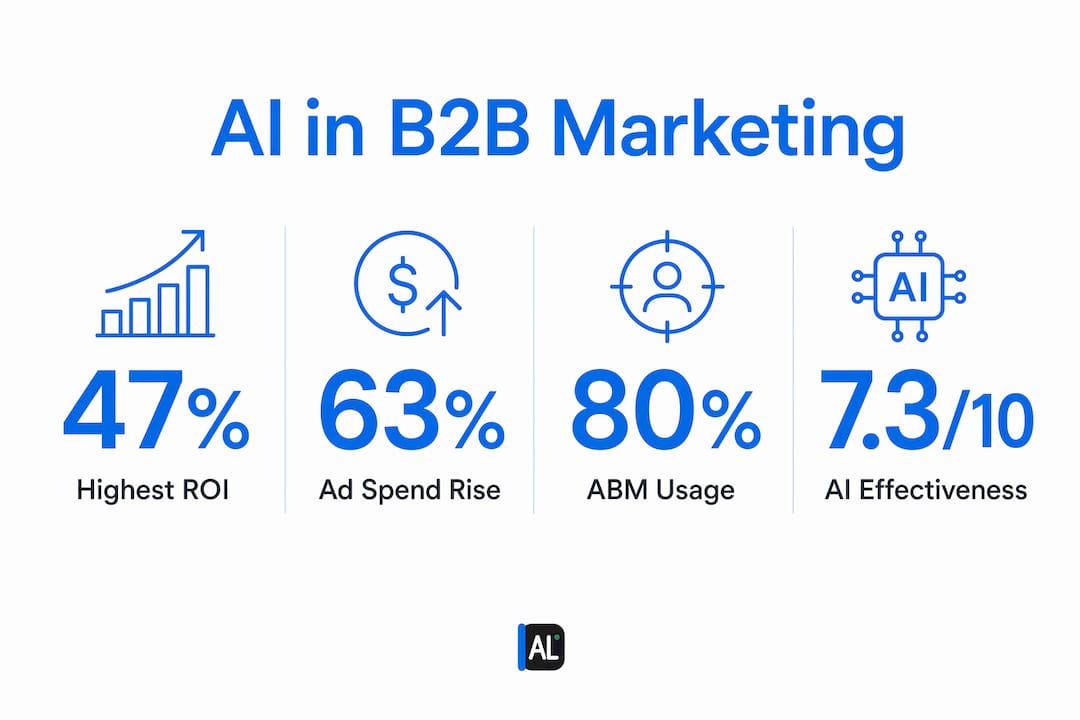
Personalised content supported by AI is the highest ROI tactic in account-based marketing programmes, with 47% of B2B marketers ranking it above all other ABM tactics. That figure reflects a structural shift: personalisation is no longer a premium add-on reserved for enterprise accounts. AI makes it the default operating mode for campaigns across all tiers.
The mechanism is straightforward. AI segments audiences by analysing behavioural patterns, content consumption history, industry vertical, company size, and buying stage simultaneously. It then maps content variants to each segment and adjusts delivery based on engagement signals in real time. What would take a marketing team weeks to configure manually, AI executes continuously across hundreds of accounts.
| Approach | Without AI | With AI |
|---|---|---|
| Audience segmentation | Manual, static, updated quarterly | Dynamic, behaviour-based, updated continuously |
| Content personalisation | Template-based, limited variants | Account-level variants generated and tested automatically |
| Campaign optimisation | Weekly or monthly review cycles | Real-time bid and message adjustments |
| ABM execution | Resource-intensive, limited to top accounts | Scalable across full target account list |
Nearly 80% of organisations now actively use ABM strategies, and AI is rated 7.3 out of 10 for improving ABM outcomes. That adoption rate signals that AI-powered personalisation is no longer a competitive differentiator. It is the baseline expectation.
The critical dependency here is data quality. AI personalisation at scale requires a consistent, cross-functional data foundation that connects marketing behaviour, CRM records, and sales activity. Without that foundation, AI generates personalised content for the wrong accounts or optimises campaigns toward the wrong signals.
Integrating AI into marketing and sales workflows for measurable impact
The distinction between using AI as a productivity tool and embedding it as a revenue workflow layer is where most B2B marketing teams either capture or forfeit their return on investment. Productivity gains from AI, such as faster content drafts or automated email sequences, are real but limited. The compounding value comes from AI operating inside the decision logic of your pipeline.
Organisations using AI-enabled sellers with next-best-action recommendations are 2.6 times more likely to achieve commercial growth, according to a Gartner survey of 227 chief sales officers. That multiplier is not explained by AI doing more work. It is explained by AI directing human effort toward the highest-value activities at the right moment.
Workflow integration at this level requires three operational components:
- Orchestration logic that connects your marketing automation platform, CRM, and intent data sources so AI recommendations are based on a complete picture of each account, not a siloed view from one system
- Defined escalation rules that specify when AI acts autonomously versus when it surfaces a recommendation for human review, preserving judgement where it matters most
- Feedback loops that feed sales outcomes back into the AI model, so the system learns from won and lost deals rather than optimising only on marketing engagement metrics
AI-enabled growth depends on redesigning seller workflows to complement AI with human judgement, not replacing one with the other. Teams that treat AI as a replacement for process design consistently underperform teams that treat it as an amplifier of well-designed processes.
Pro Tip: Before deploying any AI tool into your sales workflow, map the current state of your lead routing process on a whiteboard. Identify every point where a lead can stall or be misrouted. AI will accelerate whatever process you give it, including a broken one. Fix the routing logic first, then add AI.
| Workflow layer | AI application | Business outcome |
|---|---|---|
| Lead routing | Automated scoring and assignment rules | Faster response times, reduced lead leakage |
| Pipeline forecasting | Predictive deal scoring based on engagement | More accurate revenue projections |
| Campaign optimisation | Real-time bid and audience adjustments | Improved cost per qualified lead |
| Sales enablement | Next-best-action recommendations in CRM | Higher conversion rates from pipeline |
AI-powered ad spend is forecast to rise 63% in 2026, reflecting the scale at which B2B marketers are committing budget to AI-driven campaign execution. That investment concentration makes workflow readiness a financial imperative, not just an operational preference.
What are the common pitfalls when scaling AI in B2B marketing?
The gap between AI investment and AI impact is wider than most marketing leaders acknowledge. CMOs allocate an average of 15.3% of marketing budgets to AI, yet only 30% report readiness to scale AI capabilities, according to Gartner’s 2026 CMO Spend Survey. That gap represents a significant proportion of marketing budget deployed into systems that organisations are not operationally equipped to leverage.
The most common failure modes are predictable:
- Dirty data feeding AI models that then generate confident but incorrect recommendations, eroding trust in the system across the team
- No governance framework for how AI outputs are reviewed, approved, or overridden, leading to inconsistent execution and compliance risk
- Measuring AI success by content volume rather than pipeline contribution, which creates the illusion of productivity without demonstrating business value
- Talent gaps where marketing teams lack the analytical capability to interpret AI outputs critically, resulting in over-reliance on automated recommendations without adequate scrutiny
Scaling AI as a revenue workflow layer requires clean data, defined routing processes, and governance structures. Without these, AI adoption increases lead leakage rather than reducing it. That is a counterintuitive but well-documented outcome: more automation applied to a broken process produces faster failure, not faster growth.
Measuring AI impact based solely on content volume or efficiency metrics creates misleading results. Tracking pipeline velocity and attributable influence is the correct measurement framework. If your AI investment cannot demonstrate a contribution to qualified pipeline, the investment is not yet working.
Pro Tip: Audit your CRM data quality before evaluating any AI tool. Pull a sample of 200 records and check for missing fields, duplicate entries, and outdated company information. If more than 20% of records have significant gaps, address data hygiene first. AI tools will surface these gaps at scale and amplify their impact on your pipeline.
Key takeaways
The role of AI in B2B marketing delivers measurable pipeline growth only when it is embedded in well-designed workflows supported by clean data, clear governance, and cross-functional alignment between marketing and sales.
| Point | Details |
|---|---|
| AI as a workflow layer | Embedding AI into revenue workflows, not just content production, drives the 2.6x commercial growth advantage. |
| Personalisation at scale | AI-powered ABM personalisation is the highest ROI tactic, rated by 47% of marketers above all other approaches. |
| Readiness gap is real | Only 30% of CMOs report readiness to scale AI despite allocating 15.3% of budgets to it. |
| Data quality is foundational | Clean data, defined routing, and governance are prerequisites for AI to reduce lead leakage rather than increase it. |
| Measure pipeline, not productivity | Tracking AI success by content volume overstates impact; pipeline velocity and attribution are the correct KPIs. |
Why most B2B teams are using AI backwards
The pattern I see most consistently across B2B marketing teams is this: AI gets deployed to solve a content problem when the actual problem is a process problem. Teams invest in AI writing tools, AI ad creative generators, and AI email personalisation engines, and then wonder why pipeline numbers do not move. The content is faster and more plentiful. The pipeline is unchanged.
The teams that extract genuine commercial value from AI-driven marketing strategies are the ones that started with a different question. Not “how do we produce more content faster?” but “where in our pipeline is value being lost, and can AI address that specific point?” That reframe changes everything about how you select tools, configure workflows, and measure outcomes.
Cross-functional alignment between marketing and sales is not a soft requirement. It is the technical prerequisite for AI to function correctly. If marketing and sales are operating from different data sets, different definitions of a qualified lead, and different views of the pipeline, AI will optimise for the wrong signals with great efficiency.
The AI-driven marketing strategies that produce measurable ROI share a common characteristic: they are built on top of a clearly defined, agreed-upon revenue process. AI accelerates what already works. It does not repair what is broken. Starting with operational discipline and then adding AI is the sequence that produces compounding returns.
Work with a consultant who builds AI-powered B2B funnels

If your team is allocating budget to AI tools without seeing proportional pipeline growth, the issue is rarely the technology. It is the strategy and process architecture underneath it. Anthonyligyat works with B2B companies to build AI-powered marketing funnels that connect lead generation, qualification, and conversion into a single measurable system. With a track record that includes scaling Excelerate Consulting’s LinkedIn reach to 60,000 weekly impressions and delivering measurable funnel improvements for international brands like Yuan Packaging, the approach is grounded in data analysis and attribution, not guesswork. If you want AI to move your pipeline numbers, start with a strategy built around your specific funnel gaps.
FAQ
What is the role of AI in B2B marketing?
AI in B2B marketing automates lead targeting, personalises campaigns at the account level, and forecasts pipeline outcomes using machine learning and predictive analytics. Its primary value lies in strategy execution and real-time optimisation, not content generation alone.
How does AI improve lead qualification in B2B sales?
AI improves lead qualification by scoring prospects dynamically using intent data, firmographics, and behavioural signals, updating scores in real time as buyer behaviour changes. This ensures sales teams focus on the highest-probability accounts at any given moment.
Why do so many AI marketing investments fail to deliver ROI?
Gartner’s 2026 CMO Spend Survey found that only 30% of organisations are ready to scale AI despite significant budget allocations. The most common causes of underperformance are poor data quality, absent governance frameworks, and measuring success by content volume rather than pipeline contribution.
What is the most effective AI tactic in ABM programmes?
AI-supported personalised content is the highest ROI tactic in ABM, with 47% of B2B marketers ranking it above all other approaches according to the Demand Gen Report 2026 benchmark survey.
How should B2B marketers measure AI performance?
AI performance should be measured by pipeline velocity, marketing-qualified lead attribution, and conversion rates at each funnel stage. Productivity metrics like content output volume do not reflect the business impact of AI investment.