
Most startups do not fail because their product is bad. They fail because nobody understands what the product is for, or who it serves. Brand positioning, the strategic discipline of defining where your brand sits in a buyer’s mind relative to alternatives, is the single variable that separates funded, fast-growing startups from ones stuck explaining themselves on every sales call. Studying real startup brand positioning examples reveals patterns that no framework document can fully capture. This article breaks down what makes positioning work, then walks through concrete cases you can learn from and apply directly.
Table of Contents
- Key takeaways
- Startup brand positioning examples: the criteria that matter
- 1. Grüns: redefining the category around craveability
- 2. Glossier: owning the noun in beauty
- 3. Groie: embedded GTM positioning for B2B SaaS
- 4. Comparison of featured startup positioning examples
- My take on what founders consistently get wrong
- Work with a consultant who understands startup positioning
- FAQ
Key takeaways
| Point | Details |
|---|---|
| Position before you design | Positioning must be set before visual identity, so it functions as the north star for all brand decisions. |
| One territory, one promise | Startups that try to claim multiple values dilute recall; focus on a single, credible positioning axis. |
| Retention beats acquisition | Building habit and daily usage into your positioning creates stronger long-term brand equity than chasing new customers. |
| Map buying moments | Align messaging with the specific occasions when buyers are making decisions, not just when they are browsing. |
| Treat positioning as a system | Effective positioning integrates website narrative, sales copy, SEO, and demand generation rather than sitting in a slide deck. |
Startup brand positioning examples: the criteria that matter
Before you study any specific case, you need a clear lens for evaluating what makes positioning effective. Brand positioning, in the recognised industry sense, answers three questions with precision: who is this for, what does it offer, and why should anyone believe it. Aspirational language does not answer any of those questions.
A practical positioning statement follows a structure like this: “[Brand] is the [category] for [target audience] that [unique benefit], unlike [competitors], because [proof/reason].” This fill-in-the-blank formula forces specificity and exposes gaps in your thinking fast.
Here is what separates positioning that works from positioning that sounds good in a pitch deck:
- Narrow audience focus. The more specific the target, the stronger the resonance. “Busy professionals” is not a target. “Pre-seed SaaS founders without a dedicated marketing hire” is.
- A single, ownable benefit. Diluted positioning happens when founders try to claim too many attributes at once. Pick one territory and defend it.
- Credible proof. Every positioning claim needs a reason to believe it. Product design, customer results, category data, or a unique method all qualify.
- Category redefinition. The strongest startups do not just compete in a category. They reframe it so competitors are playing by their rules.
- Memorable identity. Positioning must be simple enough that a customer can repeat it to a friend without looking at your website.
Pro Tip: Write your positioning statement before you brief a designer. If you cannot articulate who the brand is for and why it wins, no visual system will fix that gap.
Positioning must precede design, with brand identity decisions flowing downstream from a clear strategic foundation. Founders who reverse this order spend money on logos that communicate nothing.
1. Grüns: redefining the category around craveability
Grüns is one of the most instructive startup brand positioning examples of the past five years. Launched in 2023, the supplement brand did not compete on ingredient lists or clinical efficacy claims like every other player in the greens powder space. Instead, it repositioned the entire category around a concept it called “craveability.”

The product form itself was the positioning. Grüns delivered daily nutrients as a gummy snack pack, not a powder you mix into water and force yourself to drink. That single decision separated Grüns from every competitor without needing a single comparison ad. The product was the message.
Key elements of Grüns’ positioning execution:
- Direct competitor contrasts in messaging, naming the powder category’s inconvenience explicitly
- Messaging segmentation across different audience cohorts, with tailored creative for each
- Automated creator content at scale, generating social proof without proportional cost increases
- Subscription mechanics tied to habit formation, not just convenience
The results validate the strategy. Grüns reached a $1.2 billion valuation within 32 months of launch, an outcome driven by category redefinition rather than outspending incumbents on media. The brand also achieved an 80% daily usage rate, which is the metric that actually tells you whether positioning is working. When customers use your product every day without prompting, you have embedded yourself into their identity, not just their shopping cart.
The lesson for founders is that product form and positioning are not separate decisions. How you deliver the product communicates the brand promise before the customer reads a single word of copy.
2. Glossier: owning the noun in beauty
Glossier built what strategists call “Level 4 positioning,” where the brand becomes the linguistic reference point for an entire category. Between 2014 and 2019, Glossier did not just sell beauty products. It defined what effortless, community-driven beauty meant, to the point where competitors were described relative to Glossier rather than the other way around.
This is strong brand positioning functioning as a language primitive, shaping how consumers think about an entire market. Glossier’s identity was built on a few tightly held beliefs: that beauty should feel like self-expression rather than correction, that real customers are the best spokespeople, and that product design should encode the brand promise physically.
“Glossier You” fragrance, the brand’s most direct expression of identity-driven positioning, generated $100 million in revenue by 2024 and became Sephora’s best-selling fragrance in 2023, selling one bottle every 20 seconds at peak.
What Glossier demonstrates is that aspirational positioning can work, but only when the product design and community mechanics provide the proof. The fragrance called “You” is not a product name. It is a positioning statement compressed into a single word.
The risks are equally instructive. Glossier’s broad identity positioning made it vulnerable when the cultural moment shifted. When competitors adopted similar community-first language, Glossier’s differentiation eroded because the positioning was emotional rather than functional. For founders, the takeaway is clear: identity-driven positioning requires constant cultural maintenance and a proof layer that competitors cannot easily copy.
3. Groie: embedded GTM positioning for B2B SaaS
Most examples of brand positioning focus on consumer brands, which creates a blind spot for B2B founders. Groie is a useful corrective. The company positions itself as an embedded go-to-market partner for early-stage SaaS startups, specifically those operating from pre-seed through to pre-Series A, who lack internal product marketing capability.
That targeting specificity is the positioning. Groie is not a generic marketing agency. It is not a brand consultancy. It is the partner you bring in when you have a product that works but no clear story about who it is for or how buyers will find it.
Groie’s positioning integrates messaging clarity, SEO, AEO strategies, and inbound infrastructure into a single system focused on how buyers actually discover products today. That is a meaningful departure from the standard “we do brand strategy” positioning most consultancies use.
Key differentiators in Groie’s approach:
- Audience defined by funding stage and internal capability gap, not industry vertical
- Positioning treated as a GTM system rather than a messaging exercise
- Services aligned with modern buyer discovery behaviour, including search and AI-assisted research
- Scalable model suited to startups that will outgrow the engagement and need to internalise the function
For early-stage B2B SaaS, positioning requires integrating GTM systems beyond messaging alone. Website narrative, sales narrative, SEO, and demand generation all need to express the same positioning claim. Groie’s model is worth studying because it demonstrates how a service business can use positioning to create a category it effectively owns.
4. Comparison of featured startup positioning examples
The three cases above illustrate distinct positioning strategies. This table makes the contrast explicit so you can identify which model is closest to your own situation.
| Brand | Category redefined | Target audience | Unique benefit | Proof mechanism | Positioning type |
|---|---|---|---|---|---|
| Grüns | Supplements as snack | Health-conscious consumers | Daily habit through craveability | 80% daily usage rate, $1.2B valuation | Product-form positioning |
| Glossier | Beauty as identity | Community-driven consumers | Effortless self-expression | Product design, community UGC | Identity and cultural positioning |
| Groie | GTM as embedded partner | Pre-seed to pre-Series A SaaS | Clarity and demand generation system | Stage-specific targeting, integrated GTM | Functional and audience-specific positioning |
Each approach works because it answers the three core positioning questions clearly. Grüns answers through product form. Glossier answers through cultural identity. Groie answers through audience specificity and functional integration. None of them tries to be all three at once.
My take on what founders consistently get wrong
I have seen dozens of startups sit down to write a positioning statement and walk away with something that sounds like a mission statement. The two are not the same thing. A mission statement is internal. Positioning is what a buyer understands about you before they speak to your sales team.
The most common failure mode I observe is founders building positioning around what their product does rather than what buying moment it solves. Mapping category entry points to specific decision occasions is the step most founders skip entirely, and it is the step that determines whether your messaging reaches buyers when they are actually ready to act or when they are just scrolling.
The second failure is inconsistency. Positioning only compounds if every touchpoint reinforces the same claim. Incorporating positioning into every messaging touchpoint operationally, from your website headline to your sales deck to your email nurture sequence, is what separates brands that scale from brands that plateau.
My practical advice: write one positioning statement in the fill-in-the-blank format, build a proof library of three to five supporting facts, and then audit every customer-facing asset against both. Anything that does not reinforce the core claim is working against you. Retention-focused positioning, the kind Grüns built by optimising for daily habit, builds stronger brand equity than acquisition-only approaches because it compounds over time rather than resetting with every campaign.
Work with a consultant who understands startup positioning
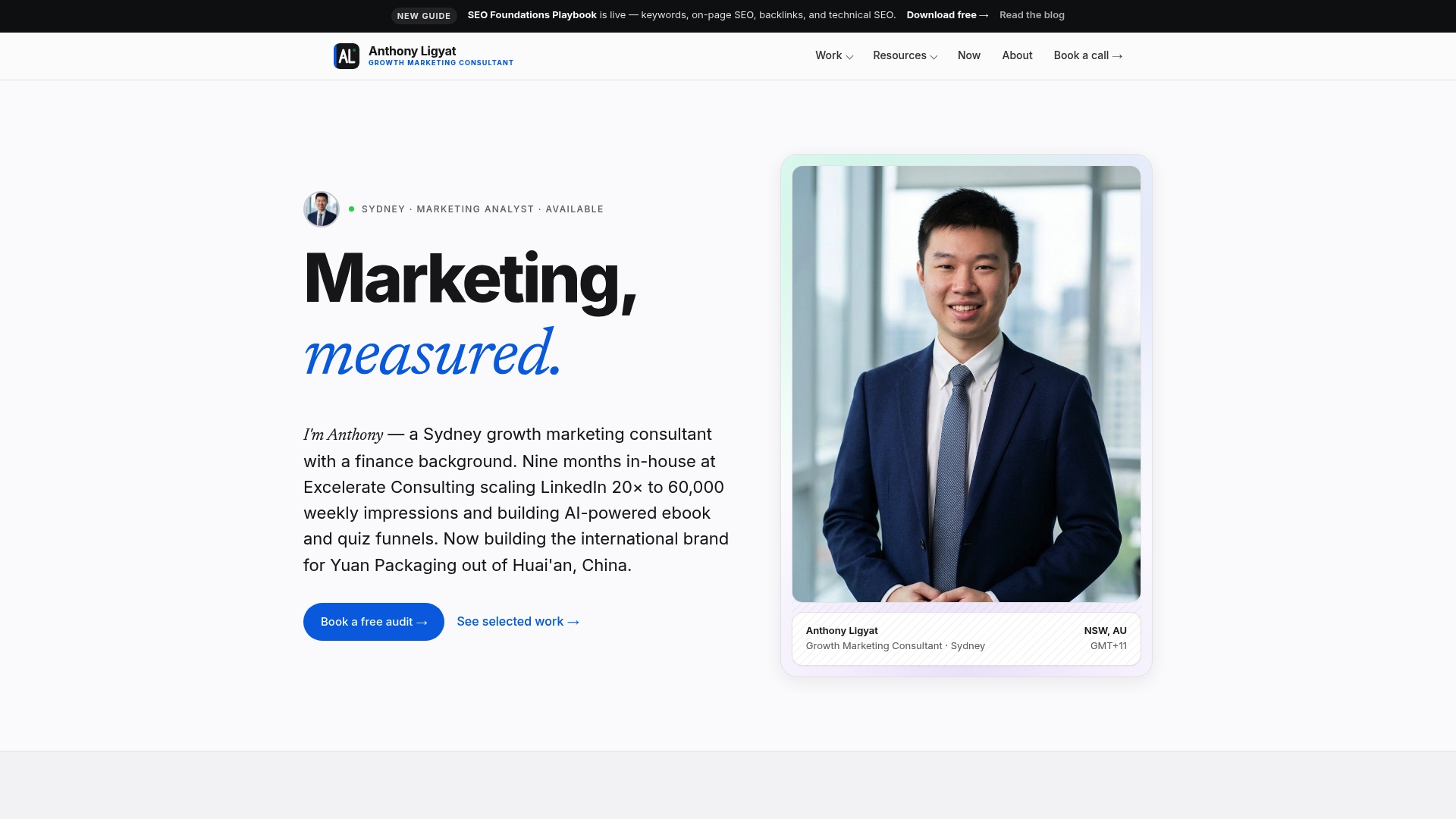
If you are a B2B founder who has read this far, you already know that positioning is not a one-afternoon exercise. It requires data analysis, audience research, and the discipline to say no to every claim that dilutes your core message. Anthonyligyat works with startups and B2B companies to build positioning that translates directly into measurable pipeline results, not just a better-looking website. With a background in finance and a track record that includes scaling client LinkedIn reach to 60,000 weekly impressions, Anthony Ligyat brings a metrics-first lens to brand strategy. If you want positioning that drives conversions rather than just compliments, explore the growth marketing services at Anthonyligyat to see how the methodology applies to your market.
FAQ
What is brand positioning for a startup?
Brand positioning is the strategic process of defining where your startup sits in a buyer’s mind relative to alternatives, answering who it is for, what it offers, and why to believe it. It is distinct from a tagline or visual identity and must be established before design decisions are made.
How do you write a startup positioning statement?
Use the structure: “[Brand] is the [category] for [target audience] that [unique benefit], unlike [competitors], because [proof/reason].” This format forces specificity and exposes gaps in your differentiation before you invest in marketing execution.
Why do most startups fail at brand positioning?
Most founders dilute positioning by claiming too many attributes at once or confuse positioning with product features. Effective positioning requires selecting one clear territory and consistently aligning all brand touchpoints, from website copy to sales narratives, around that single claim.
How long does it take to build strong brand positioning?
Positioning clarity can be achieved in weeks, but market recognition compounds over months and years. Grüns reached a $1.2 billion valuation in 32 months by maintaining consistent positioning from launch, which illustrates that early clarity accelerates long-term results significantly.
Is brand positioning different for B2B startups?
Yes. B2B positioning typically requires integrating messaging with GTM systems including SEO, inbound infrastructure, and sales narratives, because buyers conduct extensive research before engaging. Audience specificity by funding stage, company size, or internal capability gap often drives stronger differentiation than industry-based targeting alone.