
You've published your content, optimized your metadata, and hit that publish button with confidence. So why isn't Google showing your pages in search results? The answer almost always comes down to one critical process: indexing on Google.
Google's indexing system is the backbone of how search works. Without it, even your best content is essentially invisible to the billions of people searching every day. Understanding how this process functions gives you a significant advantage over competitors who are blindly waiting and hoping their pages get discovered.
In this tutorial, we'll break down exactly how Google crawls, processes, and stores your web pages in its index. More importantly, we'll walk you through the most common indexing problems that could be holding your site back, along with proven, actionable fixes you can implement today. Whether you're dealing with pages stuck in a "discovered but not indexed" limbo or struggling with crawl budget issues on a larger site, this guide covers everything you need to take control of your visibility in search results. Let's get your pages indexed properly.
What Google Indexing Actually Is (and Is Not)
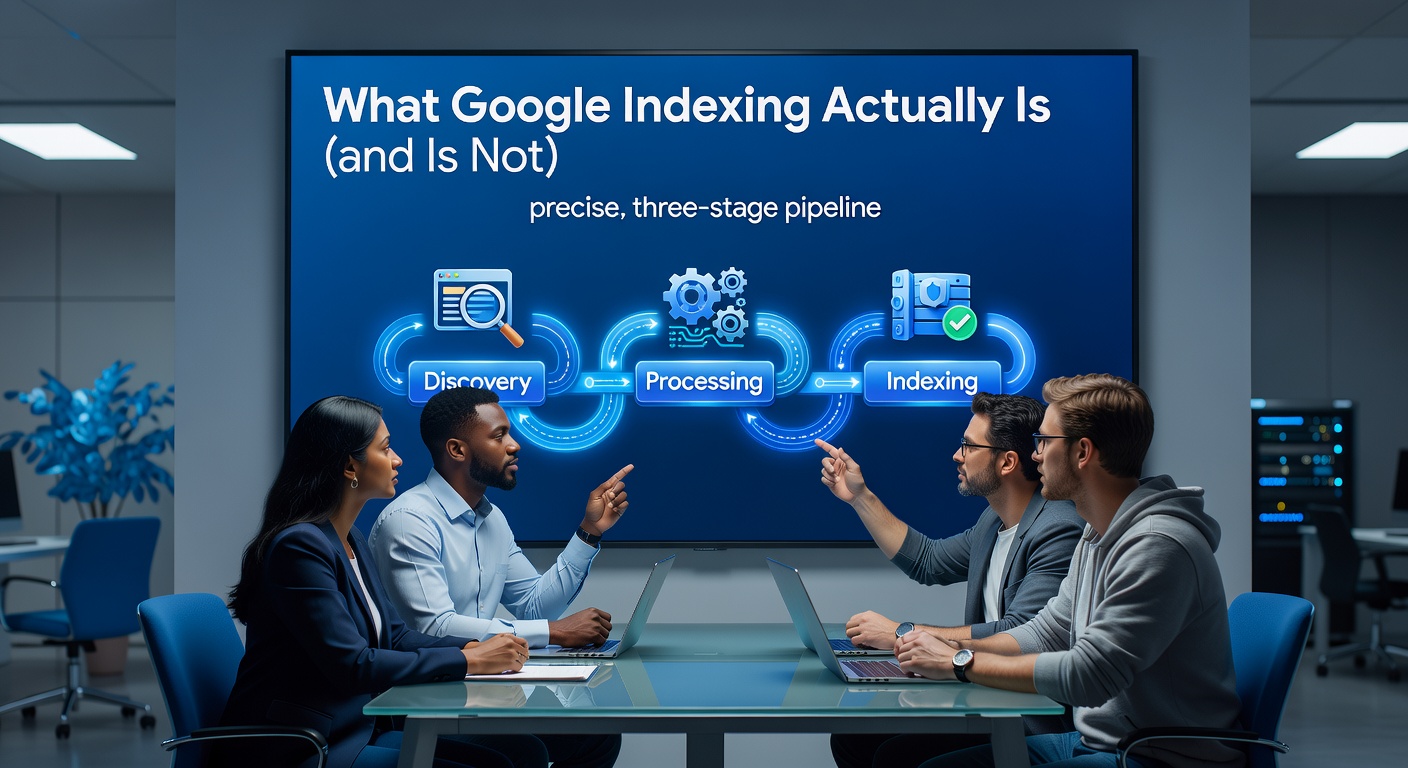
Google indexing is not simply the act of Google finding your page. It is the completion of a precise, three-stage pipeline, and every stage must succeed before your content becomes eligible to rank for a single search query. Understanding this distinction is where most intermediate marketers start closing the gap between effort and results.
The Three-Stage Pipeline: Crawl, Render, Index
The process begins with crawling, where Googlebot discovers your URL through links, sitemaps, or prior crawl data, fetches the raw HTML, and checks your robots.txt file for access permissions. Next comes rendering, where Google's Web Rendering Service processes JavaScript and CSS using a headless Chromium browser to generate the fully visible version of your page. This stage is frequently overlooked, yet research shows Google requires up to 9x more time to crawl JavaScript-heavy pages than static HTML, meaning rendering bottlenecks can delay indexing by days or longer. Finally, indexing is where Google analyzes the rendered content, evaluates quality and relevance, resolves canonical signals, and either stores the page in its index or filters it out entirely. A breakdown at any stage, whether a crawl block, a rendering failure, or a quality threshold not met, means the page never enters the index. As Google's own documentation on how search works confirms, only indexed pages are eligible to appear in results.
Published Does Not Mean Indexed
This is the gap that quietly erodes SEO and content ROI. Publishing a page makes it live on the internet. It does not guarantee Google will index it. Pages can sit in limbo states like "Crawled, currently not indexed" for weeks, months, or indefinitely, fully accessible online yet completely invisible in search. Most marketers assume that going live triggers indexing automatically; the data says otherwise.
The Scale and Stakes Involved
Google's index spans over 100 million gigabytes of data and powers more than 5 trillion searches per year. Competing for visibility inside that index is not passive. Indexing is the prerequisite on which every downstream investment depends: keyword rankings, organic traffic, lead generation funnels, and content ROI all require it. Without an index entry, backlinks, optimized metadata, and conversion pages generate zero organic return.
The stakes become clearer with large-scale data. A study analyzing over 16 million pages found that approximately 62% were not indexed, representing an enormous volume of published content that never reached a single searcher. That is not a minor inefficiency; it is a structural blind spot that compounds across every content investment a business makes.
How Google Decides Which Pages to Index

Understanding how Google decides which pages deserve a spot in its index is fundamental to building a content strategy that actually compounds over time. Indexing is not a passive, automatic process where every page gets a guaranteed entry. Google applies a sophisticated set of quality and technical filters, and the standards have grown considerably stricter heading into 2025 and 2026.
Quality Signals: E-E-A-T, Originality, and Genuine User Value
Google evaluates content against its E-E-A-T framework, which stands for Experience, Expertise, Authoritativeness, and Trustworthiness. This is not a single algorithmic lever but a collection of signals drawn from Google's quality rater guidelines, used to identify whether content genuinely serves a reader. The "Experience" component, added in late 2022, places additional weight on first-hand accounts and demonstrated real-world engagement with a topic, meaning content produced purely from secondary research increasingly struggles to compete.
Beyond E-E-A-T, originality and topical depth play a decisive role. Google actively deprioritises thin, duplicated, or scaled AI-generated content with no unique perspective. Pages that offer comprehensive coverage, original data points, or genuine insight into a subject signal to Google that the content warrants indexing and retention. Creating helpful, people-first content is not a soft recommendation; it is the primary filter through which indexing eligibility is assessed.
Technical Signals That Influence Indexing Priority
Quality signals do not operate in isolation. Technical factors determine how efficiently Google can crawl, render, and evaluate your pages in the first place. Page speed and Core Web Vitals directly influence crawl efficiency; slow-loading pages consume crawl budget without delivering reliable signals. Mobile-friendliness is equally non-negotiable, given that Google uses the mobile version of your site as the canonical input for both indexing and ranking under mobile-first indexing.
Internal link equity is the third major technical lever. Pages sitting deep within your site architecture, more than three clicks from the homepage, receive less crawl frequency and are treated as lower priority. Strong internal linking from high-authority pages signals importance and guides crawlers toward content you want indexed. Orphaned pages, those with no internal links pointing to them, are routinely overlooked regardless of content quality.
What the May 2025 Purge Revealed
The May 2025 core update triggered one of the most significant indexing purges observed in recent years. A study monitoring over two million pages found that roughly 25% were actively removed from Google's index, with some affected sites losing between 15% and 75% of their previously indexed pages. The purge disproportionately hit thin content, outdated pages, programmatically generated material, and pages that had coasted through earlier quality thresholds. The key takeaway is clear: indexing is not permanent. Google continuously reassesses whether pages continue to meet its evolving quality bar, and failing that reassessment results in deindexing.
Indexing Timelines Vary Dramatically by Authority
Site authority creates a significant disparity in indexing speed. Established domains with strong E-E-A-T signals, consistent publishing history, and healthy backlink profiles can see new pages indexed within hours. Newer or lower-authority sites face a very different reality; initial indexing on a new domain commonly takes two to four weeks, with full coverage sometimes extending to two or three months. This gap is not arbitrary. Google allocates crawl resources based on trust signals it has accumulated about a domain over time, meaning newer sites must earn prioritisation incrementally.
Indexing Is a Content Strategy Decision
The practical implication of everything above is that indexing prioritisation cannot be solved with technical fixes alone. A fast, mobile-optimised site with clean architecture still fails the indexing test if the content itself lacks depth, originality, or demonstrable expertise. The sites that compound their search visibility over time are those treating every piece of content as a proof of authority, not a volume target. Auditing and pruning low-value pages, building topical clusters around core subjects, and investing in author entity signals are content strategy decisions that directly influence how reliably and how quickly Google indexes your work.
Common Reasons Your Pages Are Not Being Indexed
Even when your crawling and rendering pipeline is functioning correctly, a range of specific technical and content issues can prevent Google from indexing your pages. Understanding each failure mode individually is what separates reactive troubleshooting from a proactive indexing strategy.
Noindex Tags: Intentional, Accidental, and How to Audit
The noindex directive is one of the most powerful signals you can send to Google, and one of the most dangerous when deployed incorrectly. When used intentionally, it serves a legitimate purpose: keeping admin pages, duplicate parameter URLs, thin archive pages, and staging environments out of the index. The problem is that content management systems can apply this tag in bulk, often silently. A WordPress plugin update, a Shopify theme change, or a misconfigured SEO plugin setting can flip noindex on for entire content categories without any visible warning in your CMS dashboard.
To audit for this, open Google Search Console and navigate to the Page Indexing report. Filter for pages excluded by the "noindex" tag and cross-reference those URLs against pages you expect to be indexed. Use the URL Inspection tool to view the rendered HTML of any suspicious page and confirm whether the tag is present at the meta or HTTP header level. Make this part of a recurring audit, particularly after any CMS update or plugin change.
Robots.txt Misconfigurations That Orphan Entire Sections
Robots.txt controls crawling, not indexing directly, but the downstream effect is the same: if Googlebot cannot access a page, it cannot index it. A single broad Disallow rule targeting a critical directory can silently remove entire site sections from Google's reach. A rule like Disallow: /blog/ looks harmless in isolation but will prevent Googlebot from ever crawling your content library. Blocking CSS or JavaScript files compounds the issue further, as Googlebot then cannot fully render the pages it does access.
Audit your robots.txt file using the GSC robots.txt tester and cross-check it against your URL Inspection results. Any page returning a "blocked by robots.txt" status needs immediate attention, as Google's official guidance on blocking indexing confirms that a noindex directive placed on a disallowed page will never even be read by Googlebot.
Crawl Errors, Orphaned Pages, and Architecture Failures
Pages with no internal links pointing to them are effectively invisible to Googlebot. These orphaned pages rely entirely on sitemaps or external links for discovery, and on large sites with constrained crawl budgets, they are routinely skipped. Beyond orphaned pages, poor site architecture creates systemic crawl waste: deep hierarchies, excessive URL parameters, redirect chains, and faceted navigation all dilute Googlebot's attention across low-value URLs rather than directing it to your most important content.
The fix requires both structural and tactical work. Audit your internal linking using a site crawler to surface pages with zero or minimal inbound links, then build contextual links from high-authority pages within your site. Resolve crawl errors flagged in GSC, consolidate redirect chains to single hops, and submit a clean XML sitemap to accelerate discovery of new content.
Duplicate and Thin Content
Google does not index pages it considers redundant or low-value when stronger alternatives exist. Duplicate content without proper canonical signals, near-duplicate pages generated by CMS templates, and thin pages with minimal original depth all trigger this outcome. In 2025 and into 2026, this issue has intensified significantly as AI-generated content has flooded the web. Google's response has been increased selectivity, with a notable purge in May 2025 removing approximately 25% of monitored pages from the index.
The solution is not volume; it is depth and originality. Consolidate weak pages into stronger ones, implement canonical tags correctly across parameter variants, and ensure every indexed page delivers genuine informational value that cannot be found identically elsewhere.
The "Crawled but Currently Not Indexed" Status
This GSC status is consistently among the most reported indexing issues in 2025 and 2026. It means Googlebot successfully crawled your page and then made a deliberate quality judgment to withhold it from the index. Community threads in Google's own support forums document spikes where sites saw this status jump from 80,000 to over 200,000 pages following the May 2025 core update. In most cases, this is a content quality signal, not a technical one. Repeatedly requesting re-crawling without improving the page will not resolve it.
JavaScript Rendering Delays
For sites built on modern frameworks like React, Vue, or Next.js, JavaScript rendering introduces a hidden indexing bottleneck. Googlebot fetches the initial HTML, then queues the page for rendering in a separate process that can take anywhere from seconds to days depending on resource availability. Content that only becomes visible after JavaScript execution may not be captured during that render window at all. Server-side rendering or static site generation removes this uncertainty by delivering fully populated HTML on the first request, making it the more reliable choice for any page where indexing speed and completeness matter.
How to Check Your Indexing Status Using Google Search Console
Google Search Console is your primary diagnostic interface for understanding how Google sees your site's indexing status. Used correctly, it shifts you from guessing why pages are missing from search results to identifying precise, actionable causes.
Using the URL Inspection Tool
To inspect a specific page, open GSC, select your verified property, and enter the complete URL (including https://) into the inspection bar at the top of the screen. You can also click "Inspect" next to any URL within most GSC reports.
The tool returns one of four core statuses. "URL is on Google" means the page is indexed and eligible to appear in results. "URL is on Google, but has issues" indicates indexing with detected problems such as structured data errors or crawl notes that may affect performance. "URL is not on Google" means the page cannot appear in search results, and the tool will surface a reason within the Page indexing or Crawl sections. "URL is an alternate version" means Google has identified a canonical elsewhere and is deferring to that version instead.
Once you review the indexed status, click Test Live URL to fetch the current live version in real time. This confirms whether your recent fixes are visible to Googlebot, though a clean live test does not guarantee indexing. If a priority page shows fixable issues, resolve them, re-test the live URL, then click Request Indexing to flag it for recrawl consideration. Note that daily request limits apply per property.
Reading the Page Indexing Report for Site-Wide Patterns
For site-wide visibility, navigate to Indexing > Pages in the left sidebar. Rather than diagnosing one page at a time, this report reveals systemic patterns across your entire crawled URL set.
The summary view displays a graph of indexed versus non-indexed pages over time alongside a breakdown table titled "Why pages aren't indexed." Sudden drops in your indexed page count warrant immediate investigation, as they often signal an accidental robots.txt change, a mass noindex deployment, or a quality-based deindexing event. The Page Indexing report in GSC also lets you filter by sitemap, which helps isolate whether issues are concentrated in submitted URLs or in pages Google discovered independently.
Click any row in the issues table to drill into up to 1,000 example URLs affected by that specific reason. From there, you can cross-reference individual pages using the URL Inspection tool and, once fixes are deployed across the affected set, submit a validation request to track resolution progress.
Coverage Categories and What Each Signals
The report groups pages into four meaningful status categories. Indexed pages are successfully stored and eligible to rank; your goal is to confirm that canonical versions of your important pages appear here rather than alternate duplicate versions. Excluded pages were intentionally or quality-based omitted. Common examples include pages blocked by a noindex tag, URLs excluded by robots.txt, and critically, "Crawled, currently not indexed," which means Google evaluated the page post-crawl and chose to exclude it based on thin content, duplication, or low perceived value.
Errors represent pages Google intended to index but could not reach, such as server errors, redirect loops, or 404s on submitted URLs. These require prompt technical fixes. Warnings (sometimes labeled "Valid with warnings" or surfaced under "Improve page experience") flag indexed pages with issues that do not block indexing but may affect Google's ability to understand or display the page correctly, such as invalid structured data or Core Web Vitals failures.
Distinguishing Temporary Crawl Issues from Quality-Based Exclusions
This distinction matters because the remediation path is entirely different. A temporary crawl issue typically appears as a server error, a "Discovered, currently not indexed" status (meaning Google found the URL but has not prioritized crawling it yet), or a spike in errors following a site migration. These often resolve once you fix the underlying technical issue, improve internal linking to shallow the page, or wait for Googlebot's next crawl cycle.
A persistent quality-based exclusion looks different. The page has been crawled successfully, the live URL test passes, but the page remains excluded under "Crawled, currently not indexed." This indicates Google evaluated the content and deemed it insufficient for inclusion. Technical fixes alone will not resolve this; the content itself needs meaningful improvement in depth, originality, or relevance before Google reconsiders.
When GSC Data Alone Is Not Enough
GSC reflects Google's perspective with inherent data lag and does not test content quality thresholds, manual actions, or whether pages qualify for AI Overviews or rich features. Several signals indicate you need a broader audit. High volumes of "Crawled, currently not indexed" across important pages, a growing gap between your indexed page count and your published page count, or discrepancies between GSC impression data and actual search visibility all suggest issues beyond what GSC can surface alone.
In these situations, combine GSC with log file analysis to verify actual Googlebot crawl frequency, a full technical crawl using a dedicated site auditing tool to catch structural issues, and a content quality review mapped against your E-E-A-T signals. The URL Inspection tool documentation explicitly notes it does not evaluate quality or security guidelines, reinforcing why GSC works best as one layer within a broader diagnostic system rather than your only source of truth.
How to Get Your Pages Indexed Faster
Once you have diagnosed your indexing gaps through Google Search Console, the next step is systematically accelerating discovery and approval across your remaining pages. There are five concrete levers you can pull, and using them in combination produces compounding results faster than any single tactic alone.
XML Sitemaps: Structure and Submission Done Right
Your XML sitemap is a direct communication channel with Googlebot, but it only works when it is clean and accurate. Use the standard sitemaps.org protocol with UTF-8 encoding and absolute URLs throughout. One critical detail that many marketers overlook: Google ignores both the <priority> and <changefreq> fields entirely, but it does read accurate <lastmod> timestamps when they are verifiable against actual page changes. This means your sitemap should only include canonical, indexable URLs with no noindex directives, no redirect chains, no 404s, and no parameter-driven duplicate pages. Including those sends conflicting signals and wastes your crawl budget. For sites with more than 50,000 URLs, split into a sitemap index file rather than one bloated file. For XML sitemap best practices aligned with Google's official guidance, the structure itself matters less than its accuracy.
Submit your sitemap through the Sitemaps report inside GSC, and also reference it directly in your robots.txt file using the Sitemap: directive. This ensures Googlebot encounters it through multiple pathways. Use a dynamic sitemap generator such as Yoast or Rank Math on WordPress so the file updates automatically as you publish or modify content. A static sitemap on an active site degrades in quality within weeks.
Internal Linking as a Crawl Acceleration Signal
A perfectly structured sitemap still cannot fully substitute for strong internal linking. Googlebot discovers pages by following links, and pages that receive links from already-indexed, high-authority pages within your site get crawled and evaluated faster. When you publish new content, immediately add contextual links to it from your most visited pillar pages, your homepage, and relevant existing posts. This signals topical relevance and importance simultaneously.
The rule of thumb used by most technical SEOs is that any page you want indexed should be reachable within three clicks from your homepage. Orphaned pages, even those listed in your sitemap, frequently stall in a "Crawled, currently not indexed" state simply because nothing links to them. Beyond homepage proximity, use breadcrumbs, related content modules, and in-content links to reinforce the hierarchy. Think of internal linking as allocating crawl budget intentionally rather than leaving it to chance.
GSC Indexing Requests: Limits and Smart Usage
The "Request Indexing" function inside the URL Inspection tool triggers Google to queue a specific URL for recrawling and re-evaluation. It is most useful for freshly published content or pages you have recently updated with significant changes. However, it carries a daily quota of roughly 10 to 15 requests per verified GSC property, and submitting the same URL multiple times does not speed up the process. Reserve your daily quota for your highest-priority pages. For bulk submissions, rely on your sitemap rather than burning through individual request credits.
Third-Party Indexing Tools: When They Add Value
Tools like Prime Indexer operate through proprietary multi-pathway signals that push URLs to Google's attention beyond the standard GSC pipeline. They are particularly valuable in two scenarios: when you are publishing at high volume and hitting GSC's daily request limits, and when pages are stuck in a "crawled but not indexed" limbo despite correct technical setup. These tools are not a replacement for solid fundamentals; they are an accelerator layered on top of them. Use them strategically for time-sensitive content launches or large backlink campaigns rather than as a default workflow.
Content Quality as the Most Durable Accelerant
No combination of technical tactics will sustain indexing for pages that Google considers low-value. Approximately 21% of indexed pages are eventually deindexed, with 13.7% removed within just three months of initial indexing. Pages that survive and rank consistently are those demonstrating clear E-E-A-T signals, original insight, and genuine user value. Technical acceleration gets your content seen faster; content quality determines whether it stays. Build every page to meet Google's selectivity threshold from the first draft, not as an afterthought.
For a structured approach to auditing all of these signals together, the free SEO Audit Checklist available at anthonyligyat.com covers crawlability, indexing status, canonical signals, internal linking, and schema as part of a complete technical audit workflow with triage prioritization built in.
AI Content and Google Indexing in 2025 and 2026
Google's approach to indexing has shifted dramatically as AI content has flooded the web. The core change is not that Google penalises AI-assisted writing; it is that Google has raised the quality bar because the cost of producing low-effort content dropped to near zero. Official guidance is explicit: original, helpful content demonstrating E-E-A-T signals will be rewarded regardless of production method. What gets penalised is scaled content abuse, meaning mass-produced pages with minimal human contribution, no original insight, and no clear value beyond manipulating rankings. By 2026, Google's systems had grown significantly better at detecting interchangeable, commodity-level content and deprioritising it from the index entirely.
AI-Assisted vs. Thin AI-Generated Content
The distinction here is operationally important. AI-assisted content production means using AI tools for drafting, structuring, or initial research, followed by substantial human review, expert input, original data, and editorial accountability. This approach can produce content that ranks strongly because the output reflects genuine expertise and satisfies user intent. Thin AI-generated pages, by contrast, are templated at scale with no meaningful human contribution. They often rehash existing content, lack attributable authorship, and fail to add anything beyond what a basic prompt already produces. Google's SpamBrain system and core quality filters specifically target this second category. Analysis of top-20 search results found that roughly 83% of top-ranking pages rely heavily on human expertise, while pure AI output captures only about 17% of those positions, a signal of how clearly the index reflects this separation.
The May 2025 Purge and What It Means for Strategy
The May 2025 de-indexing event was the clearest evidence yet that Google's selectivity had reached a new threshold. Across monitored page sets, approximately 25% of pages were actively removed from the index, with individual sites losing between 15% and 75% of their indexed pages. The pages that survived consistently shared common traits: original insights, stronger engagement signals, and identifiable authorship with credentials. The pages removed were disproportionately thin rewrites, templated AI output, and interchangeable content with no distinguishing value. The strategic implication is direct: publish fewer pages with higher individual quality rather than scaling volume for its own sake. Proactively auditing and pruning low-value pages before Google de-indexes them is now a legitimate maintenance task, not an optional one.
Structuring for AI Overviews Reinforces Indexing Priority
Content structured to earn citation in Google's AI Overviews is built on the same signals that improve indexing priority overall. AI Overviews draw from the same index and ranking systems that govern traditional results, favouring clear structure, early placement of direct answers, semantic richness, and strong E-E-A-T. Pages that meet these standards are both more likely to be indexed with priority and more likely to appear in generative summaries, creating a compounding visibility advantage.
Schema markup accelerates this further. Implementing JSON-LD with Article, Person, or FAQPage schema gives Google machine-readable confirmation of authorship, content type, and topical context. Pages with comprehensive structured data are reported to be significantly more likely to earn AI Overview citations. Semantic structure, meaning logical heading hierarchies, self-contained sections, and direct answers positioned early, complements schema by making content easier for crawlers and generative systems to parse accurately. Together, these technical signals do not replace content quality, but they remove ambiguity about what your content is and who produced it, which is precisely what Google's increasingly selective indexing systems reward.
Why Indexing Is a Funnel Problem, Not Just an SEO Problem
Most marketers treat indexing as a technical checkbox, something to hand off to a developer and forget. That framing is costly. Every unindexed page is not just an SEO miss; it is a dead funnel stage. Your lead magnet landing page, your core service page, your highest-intent case study, these assets exist on your server but produce zero organic impressions, zero clicks, and zero pipeline contribution if Google has not indexed them. According to a study of over 16 million pages, approximately 61.94% of pages studied were not indexed. That figure is not an abstract SEO statistic; it represents a majority of digital assets that are functionally invisible to any user arriving through search.
Prioritize by Business Impact, Not Crawl Volume
When you open Google Search Console and see hundreds of pages flagged as "Crawled, currently not indexed," the instinct is to fix everything at once or sort by volume. Neither approach serves your business. The correct sequencing is to map each unindexed page to its position in your revenue model. Revenue-adjacent pages, specifically your high-intent service pages, offer or pricing pages, lead magnet downloads, and conversion-focused landing pages, should be addressed first because indexing them directly unlocks pipeline potential. Thin blog archives or internal tag pages can wait. This prioritization framework turns a reactive technical task into a deliberate commercial decision, which is precisely where SEO starts compounding as a growth function.
Applying the Four-Phase Framework to Indexing
Anthony's four-phase process (diagnose, audit, build, compound) maps directly onto indexing problems in a structured way. In the diagnose phase, you use Search Console's page indexing report to identify patterns: which page types are failing, whether issues concentrate on service content or top-of-funnel posts, and whether the root cause is crawl budget, quality signals, or technical blocks. In the audit phase, you run a systematic review of robots.txt, canonical tags, internal linking depth, page speed, E-E-A-T signals, and duplicate content, starting with your revenue pages. The build phase involves implementing targeted fixes: strengthening internal links to priority pages, improving content depth, adding schema, and submitting updated sitemaps. The compound phase is where the leverage multiplies. Once core pages are indexed and ranking, they feed organic traffic into your funnel consistently without additional ad spend.
Indexing as the Foundation for Cross-Channel Compounding
There is a direct connection between indexing health and your LinkedIn content strategy that most marketers overlook. When you publish a LinkedIn post referencing a pillar page, a downloadable template, or a service overview, that content's ability to compound across channels depends entirely on the underlying page being indexed. Unindexed assets cannot receive search referrals, cannot accumulate authority signals, and cannot be surfaced in AI Overviews, which means your LinkedIn-driven traffic has nowhere credible to land and convert. Indexed, well-structured content creates a flywheel; LinkedIn drives awareness, search reinforces authority, and the indexed page captures intent from both directions.
To run this kind of audit systematically, the SEO Audit Checklist available on anthonyligyat.com is the practical companion tool. The 16-page checklist covers crawlability, indexing signals, canonical auditing, on-page elements, and schema review, and it includes a prioritization framework for turning findings into a focused 30-day action plan. Treating indexing as a funnel problem, rather than a technical formality, is what separates marketing that compounds from marketing that stalls.
The Indexing Audit You Should Run This Week
Indexing is the floor that every other SEO and content investment is built on. Keyword research, link building, content production, and conversion optimisation all depend on Google being able to find, render, and store your pages in the first place. A single unresolved noindex tag or an orphaned page can quietly nullify months of upstream work. Before layering on any additional growth tactics, confirm the foundation is solid.
Run through this checklist this week:
Check the GSC Page Indexing report: Navigate to Indexing > Pages in Google Search Console and audit the breakdown between indexed and excluded URLs. Prioritise investigating "Crawled – currently not indexed" and "Discovered – currently not indexed" statuses on your highest-value pages.
Audit for noindex tags: Scan your site for accidental noindex directives in meta robots tags, HTTP headers, or robots.txt files. Misconfigured plugins and staging environments are common culprits.
Verify sitemap submission: Confirm your XML sitemap is submitted under Indexing > Sitemaps and contains only canonical, high-value URLs.
Review internal linking on key pages: Orphaned pages receive fewer crawl signals. Ensure priority pages are linked from frequently crawled, authoritative sections of your site.
Assess content against E-E-A-T signals: Pages sitting in "not indexed" statuses often lack demonstrable expertise, original insight, or trustworthiness indicators. Strengthen those signals before requesting re-evaluation.
Research covering over 16 million pages confirms that roughly 93% of eventually indexed pages are indexed within six months. Fixing blockers early compounds quickly; every additional indexed page becomes eligible to rank, earn links, and drive traffic sooner.
For a structured starting point, work through the SEO Audit Checklist available at anthonyligyat.com. For persistent or complex issues, the four-phase diagnostic process covers crawlability and indexation first, then site architecture, content quality, and performance in sequence, ensuring you resolve foundational gaps before optimising anything else.
Conclusion
Getting your pages indexed by Google is not a passive process. It requires deliberate action, ongoing monitoring, and a clear understanding of how the system works.
Here are the key takeaways to carry forward:
Google must crawl, process, and store your page before it can rank
Technical barriers like blocked URLs and poor site structure are the most common culprits
Tools like Google Search Console give you direct visibility into indexing issues
Small, consistent fixes compound into significant ranking improvements over time
Now it is time to take action. Open Google Search Console today, audit your coverage report, and identify any pages stuck in indexing limbo. Every day a valuable page goes unindexed is a day you are leaving traffic on the table.
You have the knowledge. Use it to make your content impossible for Google to ignore.