Every successful brand you admire, every campaign that made you stop scrolling, and every product that felt impossible to ignore all have one thing in common: they were built on solid marketing fundamentals. Without a strong foundation, even the biggest budgets and boldest ideas will fall flat.
If you are new to the world of marketing, the sheer volume of strategies, platforms, and terminology can feel overwhelming. The good news is that mastering marketing fundamentals does not require years of experience or a formal degree. What it requires is the right guidance and a willingness to learn.
This complete guide for 2026 is designed specifically for beginners who want to build real, lasting marketing knowledge from the ground up. You will learn what marketing actually is, why it matters, and how the core principles apply across every industry and business size. By the end of this tutorial, you will have a clear understanding of the essential concepts, tools, and strategies that form the backbone of effective marketing. Let us start building your foundation right now.
What Are Marketing Fundamentals and Why They Still Matter
At its core, marketing is the process of creating, communicating, and delivering value to a target audience in exchange for something of worth. This definition, endorsed by the American Marketing Association, goes far beyond advertising or promotion. It encompasses understanding what your audience genuinely needs, building an offer that satisfies those needs, and establishing the trust required for an exchange to take place. Every effective marketing strategy, regardless of industry or budget, is built on this simple but powerful logic.
The reason fundamentals endure is the same reason sound financial principles never go out of style. Concepts like compounding interest, diversification, and the time value of money hold true whether markets are booming or collapsing. Marketing works the same way. Audience psychology, perceived value, and the mechanics of trust do not change because a new social platform launches or an algorithm updates. Tactics are the vehicles; fundamentals are the road.
The most common mistake beginners make is chasing tactics without a strategic foundation in place first. Pouring budget into the latest ad format or trending channel without understanding your audience, positioning, or value proposition leads directly to diminishing returns. Any single channel, pushed hard enough without strategic grounding, will eventually plateau or decline in ROI.
In 2026, with 92% of marketers reporting that AI has already reshaped their roles, the temptation to prioritize tools over thinking is stronger than ever. But AI changes execution, not the underlying logic of audience, value, and exchange. It amplifies your strategy; it cannot replace one.
This tutorial will walk you through each core component, showing you how to connect them into a compounding marketing system that builds momentum, trust, and measurable results over time.
The 4 Ps of Marketing: The Foundation Every Strategy Needs
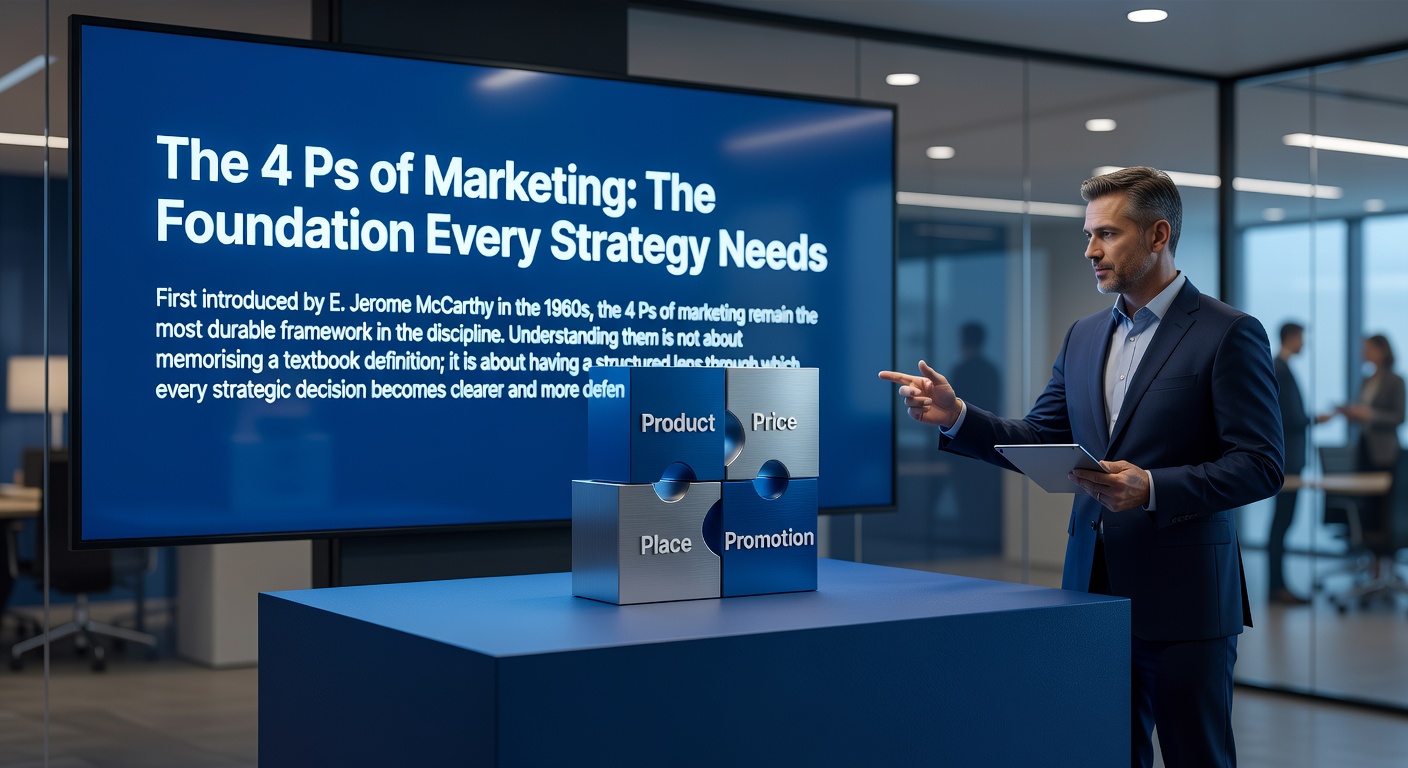
First introduced by E. Jerome McCarthy in the 1960s, the 4 Ps of marketing remain the most durable framework in the discipline. Understanding them is not about memorising a textbook definition; it is about having a structured lens through which every strategic decision becomes clearer and more defensible.
Breaking Down Each P
Product is what you sell, but more precisely, it is the problem you solve and the reason a customer chooses you over every available alternative. Differentiation lives here. A consulting service, a SaaS tool, and a physical product all need to answer the same question: why should someone choose this over doing nothing or choosing a competitor? Your product's features, quality, packaging, and positioning all feed into this answer.
Price is the only P that generates revenue rather than creating cost. It signals value before a customer ever uses your product. A premium price communicates quality and exclusivity; an aggressively low price can undercut perceived value even when the product is excellent. Pricing strategy sits at the intersection of your costs, your customer's willingness to pay, and the position you want to hold in the market.
Place refers to how and where your audience accesses what you sell. Traditionally this meant retail locations and distribution networks. In a digital context, Place now includes your website, organic search rankings, LinkedIn, marketplaces, and increasingly, AI-powered discovery channels. When someone asks an AI assistant for a recommendation and your brand appears, that is a Place decision playing out in real time.
Promotion covers every way you communicate your value: content marketing, paid advertising, SEO, email, social media, and PR. It is the most visible P, and often the most over-invested one.
The 4 Ps as an Interconnected System
The critical mistake beginners make is treating these four elements as a checklist rather than a system. Each P influences and depends on the others. A premium product paired with budget-level pricing and discount-store distribution sends conflicting signals that erode customer trust. Equally, heavy investment in Promotion cannot rescue a product that lacks genuine market fit. Awareness without conversion is simply expensive noise. Every element must reinforce the same core promise.
A Simple Self-Audit You Can Run Today
Start by writing one sentence for each P that describes your current position. Then ask whether all four sentences tell the same story. If your Product solves a specific professional problem, does your Price reflect specialist expertise? Does your Place put you where that professional actually looks for solutions? Does your Promotion speak their language? Gaps between your answers reveal where the strategy is leaking.
The Most Common Misapplication
The single most frequent error, particularly among early-stage businesses, is over-investing in Promotion while neglecting Product-market fit. More ad spend and more content will not fix a pricing strategy that undervalues the offer or a distribution approach that targets the wrong audience entirely. According to Coursera's marketing research, foundational alignment across all four elements consistently outperforms heavy spend concentrated in a single area.
Connecting the 4 Ps to Modern Digital Execution
The questions the framework asks have not changed, but the answers look very different in 2026. Place now demands that you think about the full marketing mix across organic search, LinkedIn for B2B audiences, and AI-generated discovery, where your content either surfaces in an AI answer or it does not exist for that user. Promotion increasingly requires dual optimisation: traditional SEO alongside generative engine optimisation for AI citations. Product differentiation is sharpened by first-party data and continuous customer feedback loops. Price decisions are informed by real-time competitive intelligence. The 4 Ps did not become obsolete with digital transformation; they became more powerful tools for navigating it.
The 7 Ps Framework: When to Extend Beyond the Basics
The 4 Ps framework built a solid foundation, but when your business sells a service rather than a physical product, three additional elements become equally critical to your marketing success. The extended 7 Ps marketing mix, formalized by Booms and Bitner in 1981, adds People, Process, and Physical Evidence to address the unique challenges that services present. Unlike products you can hold, inspect, or return, services are intangible and highly variable, meaning customers must evaluate your credibility before they can experience your value.
People refers to every individual who touches the customer relationship, from frontline consultants to support staff to leadership. In a service business, your team literally is the product. Their expertise, responsiveness, and professionalism directly shape how prospects perceive your brand before a single dollar changes hands.
Process covers the systems and workflows that deliver your service consistently. This is not just an operational concern; it is a core marketing lever. A streamlined onboarding flow, a clear project communication cadence, and a frictionless checkout experience all reduce drop-offs at every funnel stage. At the awareness level, this means easy content access and fast website navigation. At the decision stage, it means transparent pricing and simple sign-up steps. At retention, it means proactive updates and structured review cycles that keep clients engaged and loyal.
Physical Evidence is perhaps the most immediately actionable of the three additions, especially in 2026. For service businesses, physical evidence encompasses every tangible signal of credibility: testimonials, published case studies, certifications, professional website design, and detailed results documentation. This maps directly onto modern trust signals as outlined by the 7 Ps framework, including Google's E-E-A-T principles of Experience, Expertise, Authoritativeness, and Trustworthiness. A consultant who publishes audited results, client outcomes, and authoritative guides is building physical evidence in digital form.
The 7 Ps framework becomes essential over the 4 Ps in any context where trust, relationships, and delivery consistency drive differentiation. This includes independent consultants, B2B agencies, SaaS platforms, financial services firms, and healthcare providers. These are environments where perceived risk is high and customers need reassurance before committing.
A Concrete Example in Practice
Consider a B2B growth marketing consultancy applying all 7 Ps deliberately. The Product is a tiered strategy package with clear deliverables. Price uses value-based tiers tied to measurable outcomes. Place is primarily digital, with a client portal centralizing all deliverables. Promotion relies on E-E-A-T-focused case studies and LinkedIn thought leadership. People means trained consultants who prioritize responsiveness and client education. Process includes a standardized discovery, audit, execution, and review cycle with automated project management reducing response times. Physical Evidence includes a fast-loading professional website, published results showing "+45% organic traffic" for named clients, Google Partner credentials, and polished monthly reports.
When this consultancy tightened its onboarding process and amplified its case study library, it reported a 40% reduction in onboarding friction and a 30% improvement in lead-to-client conversion. That outcome illustrates exactly why the 7 Ps matter: individually, each element adds value, but aligned together, they compound into a measurable competitive advantage.
Audience Research, Segmentation, and Building a Value Proposition
Understanding who you are marketing to is just as important as knowing what you are selling. Without a clear picture of your ideal customer, even the most well-crafted message will miss its mark, wasting budget and slowing growth.
Building Your Ideal Customer Profile
An Ideal Customer Profile is a data-driven description of the customer who delivers the highest lifetime value, the shortest sales cycle, and the lowest churn. For beginners, think of it as a blueprint that guides every marketing decision, from the channels you choose to the words you use in an ad. ICP development works across four dimensions. Firmographic data covers B2B-specific traits such as industry, company size, revenue range, and technology stack; for example, targeting fintech SaaS companies with 50 to 500 employees using cloud-based infrastructure. Demographic data applies to the individual decision-maker, covering job title, seniority, education, and location. Psychographic data captures values, motivations, and risk appetite, such as whether your buyer prioritises innovation or stability. Finally, behavioural data examines purchasing patterns, content consumption habits, and channel preferences. Combining all four dimensions gives you a complete, actionable profile rather than a vague guess.
Core Segmentation Methods
Once your ICP is defined, segmentation allows you to divide a broader market into distinct groups so you can tailor messaging and offers precisely. Geographic segmentation groups buyers by location; a consulting firm might adjust its positioning for Sydney-based clients versus those in regional markets, accounting for different competitive dynamics and buyer expectations. Psychographic segmentation goes deeper, grouping by attitudes and values; a digital agency could separate clients who are early AI adopters from those who are more cautious, then craft entirely different pitches for each. Needs-based segmentation is particularly powerful for service businesses, where one client segment needs fast execution while another prioritises long-term strategic support. Value-based segmentation separates buyers by their willingness to pay and lifetime value potential, helping you allocate sales and marketing resources toward the most profitable relationships. In B2B contexts, combining firmographic and needs-based methods typically delivers the sharpest targeting because buying decisions involve multiple stakeholders with different priorities.
Value Proposition Frameworks That Actually Work
Two frameworks stand out for translating audience research into compelling positioning. The Jobs-to-be-Done (JTBD) approach treats every purchase as a customer "hiring" your product or service to accomplish a specific outcome. In practice, you interview customers to uncover the functional job (manage leads faster), the emotional job (feel confident in pipeline reporting), and the social job (look data-driven to the board). This informs messaging that speaks directly to real motivations rather than assumed features. The Value Proposition Canvas, developed by Alexander Osterwalder, pairs a Customer Profile (jobs, pains, and gains) against a Value Map (your offerings, pain relievers, and gain creators). Sketch both sides, then look for direct overlaps; those overlaps represent your strongest, most credible claims.
First-Party Data and the Cost of Getting It Wrong
Audience research does not just inform strategy; it defines what data you should be collecting. As third-party cookies continue to erode, first-party data, information collected directly from your audience through your own channels, is becoming the primary asset of any marketing operation. First-party data reliance is projected to reach 88% by 2027, meaning businesses that have not yet built owned data assets around their ICP are already falling behind. Every survey, CRM record, and website interaction is an opportunity to validate and enrich your customer profiles at no additional media cost.
A sharp value proposition directly reduces your Customer Acquisition Cost by improving message-to-audience fit. When your ad creative, landing page copy, and email subject lines all reflect the exact jobs, pains, and gains of a well-defined segment, click-through rates rise, conversion rates improve, and wasted impressions fall. This compounding effect means that market segmentation is not just a strategic exercise; it is one of the highest-leverage ways to make every marketing dollar work harder across every channel you use.
Channels, Content, and the Full-Funnel Approach
Choosing the right marketing channel is not about following what is trending on social media this week. It is about understanding where your audience actually spends time, how they make decisions, and which stage of the buying journey they are currently in. A channel that works brilliantly for generating awareness will often perform poorly when used to push a bottom-of-funnel conversion, and vice versa. Effective channel selection means asking three questions before committing budget: Is my target audience present and active here? Does this channel serve the funnel stage I am targeting? Do I have the resources to execute consistently and measure results accurately?
The 2026 Channel Mix Worth Understanding
Several channels now form the backbone of a well-rounded strategy, each serving a distinct purpose.
SEO and GEO for discovery remain the most compounding investments available to marketers. Traditional SEO builds long-term organic visibility, but a newer discipline called Generative Engine Optimization (GEO) has emerged alongside it. As AI-powered tools answer search queries directly without sending users to websites, marketers must now optimise content to earn citations inside those AI-generated responses. This means prioritising E-E-A-T signals, structured question-and-answer formats, and authoritative content that AI systems recognise as trustworthy.
LinkedIn for B2B authority is the clearest example of channel-audience alignment. If your business sells to other businesses, LinkedIn is where your buyers research, evaluate, and form opinions before a single sales conversation begins. Video content on the platform drives significantly higher engagement than text alone, making it a dual-purpose channel for both reach and credibility-building.
Video as the dominant content format applies across short-form and long-form contexts. Short-form video builds reach and algorithm visibility quickly, while long-form supports deeper education and trust over time. Both formats serve different funnel stages and can work together within a single strategy.
Email marketing consistently delivers the strongest documented ROI of any digital channel, with some studies citing returns of approximately 3,800% or roughly $38 for every $1 spent. It excels at nurturing leads, re-engaging past customers, and driving direct purchases through personalised sequences.
Why Single-Channel Dependence Is a Strategic Risk
Relying entirely on one channel creates compounding vulnerability. Algorithm changes, rising ad costs, audience fatigue, and platform policy shifts can erode performance with little warning. A diversified but prioritised approach, built around two or three core channels supported by complementary ones, creates resilience without diluting focus. Diversification also unlocks synergies, where video content strengthens SEO performance, and email sequences reinforce the trust built through LinkedIn.
Full-Funnel Accountability Replaces Siloed Reporting
The most important shift in modern marketing thinking is treating the funnel as one connected system rather than separate departmental responsibilities. Brand-building content at the awareness stage directly influences how quickly leads convert at the bottom of the funnel, because trust and familiarity reduce friction during the buying decision. Replacing last-click attribution with unified measurement across all touchpoints gives marketers a complete picture of what is genuinely driving revenue.
Complementing these core investments, micro-communities and conversational AI experiences represent the emerging engagement layer. Niche, high-trust communities build loyalty that broad-reach channels cannot replicate, while AI-powered chat tools enable real-time personalisation at scale, meeting buyers precisely where they are in their journey.
Measurement and Analytics: The Fundamental Most Marketers Skip
Without measurement, every marketing decision you make is an educated guess. You might produce compelling content, run paid campaigns, and optimise your website, yet without a feedback loop connecting those activities to real outcomes, you have no way of knowing what is working, what is wasting budget, or where to double down. Measurement transforms marketing from a series of disconnected experiments into a self-improving system. Each campaign generates data, that data informs the next decision, and over time the entire operation becomes sharper, faster, and more efficient. This compounding logic is precisely why analytics is not a bolt-on consideration; it is the foundation that makes every other fundamental discussed in this guide genuinely useful.
Understanding ROI Benchmarks
Before you can interpret your results, you need a reference point. Industry standards provide clear directional benchmarks for marketing return on investment. A 5:1 revenue return, meaning five dollars generated for every dollar spent, is widely considered strong performance across most channels and business contexts. A 10:1 ratio is exceptional and typically reflects a highly optimised programme with mature attribution and strong customer retention. Anything below a 2:1 return is often unprofitable once you account for overhead, staffing, technology costs, and the true cost of delivering your product or service. These benchmarks vary by industry and sales cycle length, so treat them as calibration tools rather than rigid targets. The point is to establish a baseline so you can identify which activities are genuinely contributing to growth and which ones are quietly eroding your budget.
Attribution: From Single-Touch to Unified Frameworks
For years, most marketers relied on last-click attribution, a model that gives full credit for a conversion to the final touchpoint a customer interacted with before purchasing. This approach is simple but deeply misleading. It ignores every earlier touchpoint, from the blog post that introduced your brand to the retargeting ad that re-engaged a warm prospect. Multi-touch attribution (MTA) addresses this by distributing credit across the entire customer journey, giving you a more accurate picture of which channels and messages are genuinely influencing decisions. Marketing mix modeling (MMM) takes a different approach, using aggregate historical data to assess broader channel contribution, including offline activity and incrementality. In 2026, these two methodologies are converging into unified measurement frameworks that combine the granularity of MTA with the strategic breadth of MMM. Enterprise adoption of this unified approach sits at approximately 27% in 2026, meaning the majority of organisations are still operating with incomplete measurement. For beginners, the key takeaway is simple: the more accurately you understand which touchpoints drive value, the more precisely you can allocate budget.
The LTV:CAC Ratio as a Finance-Grade Metric
One metric separates growth-oriented marketers from those simply generating activity: the ratio of customer lifetime value to customer acquisition cost (LTV:CAC). To calculate it, divide your LTV by your CAC. CAC equals your total sales and marketing spend divided by the number of new customers acquired in a given period. LTV equals average revenue per customer multiplied by gross margin and average customer lifespan. A healthy benchmark is 3:1 or higher, meaning the value a customer delivers over their lifetime is at least three times what it cost to acquire them. This ratio reframes marketing as an investment decision, not a line item expense.
The Compounding Case for Advanced Analytics
Organisations that adopt advanced analytics practices see 49% faster profit growth compared to those relying on intuition alone. This is the compounding logic of treating marketing as a measurable asset. Accurate measurement justifies budgets, enables smarter reallocation, and builds predictive capabilities that improve every subsequent cycle. As you build this infrastructure, one critical consideration is data ownership. With third-party cookie deprecation and tightening privacy regulations reshaping the digital landscape, owned data assets, including email lists, loyalty programmes, and logged-in user experiences, are becoming the most reliable foundation for accurate reporting. Privacy-first measurement is not a compliance exercise; it is a strategic advantage that ensures your analytics remain accurate, trustworthy, and future-proof as the digital environment continues to evolve.
How AI Is Reshaping Marketing Fundamentals in 2026
The numbers make it impossible to ignore. According to recent industry data, 92% of marketers report that AI has already impacted their role, and AI analytics adoption has surged from 31% in 2024 to 56% in 2026, crossing the majority threshold for the first time. Teams using AI-powered analytics report up to 64% faster time-to-insight and meaningfully better forecast accuracy. For beginners learning marketing fundamentals today, this context matters because AI does not replace the principles covered in this guide; it amplifies them. The marketers who benefit most are those who already understand audience research, measurement, and strategic thinking. Those who skip the fundamentals and reach for AI tools first tend to move faster in the wrong direction.
AI Agents Are Automating the Execution Layer
AI agents represent a significant evolution beyond simple automation. Rather than completing one task at a time, they execute multi-step marketing workflows with minimal ongoing human input. A single agent can handle content scheduling and publishing, audience segmentation, bid management, lead scoring, and performance reporting, all in sequence and in response to real-time data. Think of them as digital team members operating within defined guardrails. For example, an agent might monitor campaign performance overnight, identify underperforming ad sets, reallocate budget toward higher-converting variants, and deliver a summary report before your morning coffee. This frees you to focus on strategy, positioning, and decisions that require genuine creative and commercial judgment.
Hyper-Personalization Raises the Bar for Audience Understanding
Generative AI now enables real-time personalised content at a scale that was previously impossible. Dynamic website variants, tailored email sequences, individualised product recommendations, and audience-specific ad creatives can all be produced and deployed automatically based on a visitor's behaviour, intent signals, and context. However, this capability is only as good as the audience data behind it. Poor segmentation, shallow customer research, or unreliable first-party data leads to personalisation that feels irrelevant or intrusive. This is why the audience research and value proposition work covered earlier in this guide is not optional groundwork; it is the prerequisite that makes AI-driven personalisation effective rather than embarrassing.
GEO Is the New SEO Frontier
Generative Engine Optimisation, commonly referred to as GEO, is emerging as a critical discipline alongside traditional SEO. As AI-powered platforms like Google's AI Overviews and other generative search tools answer queries directly, users increasingly receive answers without clicking through to websites. Optimising for these environments requires stronger E-E-A-T signals (Experience, Expertise, Authoritativeness, and Trustworthiness), original research, expert authorship, transparent sourcing, and structured content formats such as clear headings, data tables, and Q&A layouts that AI systems can parse and cite. Brands that treat AI search platforms as distinct discovery channels and build content accordingly will maintain visibility. Those who rely solely on legacy SEO approaches risk being filtered out of the conversation entirely.
AI Accelerates Strategy; It Does Not Replace It
AI-assisted content production systems work best when they are designed to accelerate fundamentals-driven strategy rather than substitute for it. Use AI for speed on execution tasks such as research, initial drafts, repurposing existing content, and optimisation suggestions. Keep human judgment in control of positioning, brand voice, audience alignment, and final quality review. This hybrid approach produces higher output without sacrificing strategic coherence.
The most important warning for any beginner is this: adopting AI tools without a measurement system in place amplifies activity, not results. More content, more campaigns, and more automated workflows simply generate more noise if there is no feedback loop connecting outputs to outcomes. Build your measurement foundation first, define your KPIs, establish baselines, and then introduce AI as an accelerant to a system that is already designed to compound over time.
Putting It Together: A Four-Phase Marketing Approach That Compounds
Everything covered so far in this guide, from the 7 Ps to audience segmentation, full-funnel strategy, measurement infrastructure, and AI integration, only delivers its full potential when organised into a coherent, repeatable system. That system is a four-phase framework built around four actions: Diagnose, Audit, Build, and Compound. Think of it as the practical architecture that transforms isolated fundamentals into a marketing engine that improves with every cycle.
Phase 1: Diagnose
The first phase is about understanding exactly where you stand before making any changes. You map your current customer funnel from awareness through to consideration, conversion, and retention, then identify where value is being created and where it leaks out. A lead drop-off between the consideration and conversion stages, for example, signals a breakdown in either messaging, offer clarity, or trust signals. This is where the baseline metrics you established in the measurement section become essential. Using your ROI benchmarks and your LTV:CAC ratio, you quantify the cost of each leak and prioritise by financial impact. A healthy LTV:CAC benchmark sits around 3:1 for most businesses; if yours falls below that, the diagnostic phase will surface exactly which funnel stage is dragging the ratio down. Without this foundation, every subsequent decision is guesswork rather than strategy.
Phase 2: Audit
With your diagnosis complete, the audit phase takes a structured pass through every element of your marketing mix. Working through the 7 Ps systematically, you assess whether your product genuinely meets customer needs, whether your pricing reflects perceived value, whether your distribution channels reach the right audience, and whether your promotion resonates at each funnel stage. The audit extends beyond the framework itself to include channel-level performance data, content quality, and attribution gaps that may be masking your true ROI. The goal is not to fix everything at once; it is to rank issues by leverage. A misaligned pricing strategy affecting conversion rates will almost always outrank a cosmetic refresh of your social media visuals. Prioritising the highest-leverage fixes ensures your energy and budget compound rather than scatter.
Phase 3: Build
The build phase is where strategy meets execution. Using the strategic clarity gained in phases one and two, you construct AI-assisted content production and distribution systems designed to operate consistently at scale. This means building repeatable workflows: content templates, editorial calendars, automated distribution sequences, and AI-assisted drafting processes that maintain brand voice while dramatically increasing output capacity. Critically, you are not layering AI onto a broken foundation. Because the diagnosis and audit have already identified what the funnel needs and what the audience responds to, every asset produced in this phase serves a defined strategic purpose rather than filling a content calendar for its own sake.
Phase 4: Compound
The final phase is what separates this framework from a one-time project. Every campaign you run and every piece of content you publish feeds data back into the system. Your measurement infrastructure tracks what performs, refines your attribution model, and signals where to reinvest. Over time, small consistent improvements accumulate. Content that ranks higher drives lower CAC. Better attribution reveals which channels to scale. Refined audience segments lift conversion rates incrementally.
This mirrors compound interest in finance precisely. A small, consistent return on a well-measured base does not grow linearly; it accelerates. The same principle applies here. Early investment in diagnosis, auditing, and building solid systems establishes the base. Each subsequent iteration, a better-performing piece of content, a tighter audience segment, a more efficient paid channel, earns returns on top of previous gains. Over twelve to twenty-four months, the cumulative effect of those incremental improvements is transformative in a way that no single campaign ever could be.
Next Steps: Free Resources to Apply These Fundamentals
Here are five takeaways worth carrying forward from this tutorial. First, always map your full funnel before choosing any tactic. Second, build your audience strategy around qualified intent rather than broad reach. Third, establish a minimal measurement dashboard before you scale anything. Fourth, use AI production systems to multiply output without multiplying effort. Fifth, treat every improvement as compounding rather than one-off, because fundamentals that are tracked and iterated on grow stronger over time.
To operationalise these ideas immediately, anthonyligyat.com offers a free resource library including marketing playbooks, funnel audit templates, and measurement guides. The SEO Foundations Playbook, AI Content Playbook, Ebook Funnel Framework, and LinkedIn Growth Tracker each translate a specific section of this tutorial into a working document you can apply this week.
If your business is ready to move beyond self-guided learning, a free 30-minute funnel diagnosis is available. Submit your site URL and a brief description of your current challenge, and receive a prioritised punch list identifying your biggest leak and where to focus first.
For deeper reading, explore the guides covering Generative Engine Optimisation, LinkedIn growth frameworks, analytics setup, and AI video production. Each builds directly on the fundamentals introduced here.
The single most useful next step is not buying anything. It is diagnosing what is already broken. Start there.
Conclusion
Marketing fundamentals are not just theory. They are the proven building blocks behind every brand that earns attention, trust, and loyalty in a crowded marketplace.
Here are the key takeaways to carry forward:
- Strong foundations matter. Strategy always outperforms guesswork.
- Core principles apply everywhere, regardless of industry or business size.
- Marketing is learnable. Experience helps, but the right knowledge accelerates everything.
- Consistency and clarity separate forgettable brands from unforgettable ones.
Now it is time to put what you have learned into action. Start small, stay curious, and build your skills one step at a time. Revisit this guide whenever you need a refresher, and remember that every marketing expert once stood exactly where you are standing right now.
Your marketing journey starts today. Make it count.